Imagine you’ve just switched internet providers.
The new connection is working. Your old Spectrum router is sitting on the kitchen counter, ready to be returned. There’s just one last thing to do: cancel the old service.
You’re halfway through the month, so you assume Spectrum will refund the unused days.
That sounds reasonable. Unfortunately, it isn’t how Spectrum normally bills its residential customers.
Under Spectrum’s residential terms, canceling halfway through a monthly service period doesn’t reduce that month’s charge. You still owe the full month unless applicable state law requires otherwise.
But here’s the part worth paying attention to: if your cancellation isn’t effective by the last day of your current service period, Spectrum’s terms say you’ll be charged for the next full period, too.
And the modem or router still sitting in your house? That has a separate return deadline.
So before you cancel, there are two things to figure out: when your current service period ends, and how long you have to return Spectrum’s equipment after termination.
The Date on Your Statement Matters More Than the Day You Stop Using Internet
Let’s say your Spectrum statement shows this service period:
June 4 – July 3
This is a hypothetical example, not a real customer’s bill.
Now imagine two situations.
In the first, you switch providers and your Spectrum cancellation becomes effective June 18.
In the second, you keep Spectrum longer and your cancellation becomes effective July 2.
Under Spectrum’s standard residential terms, both situations carry the same full monthly service charge for June 4 through July 3.
Canceling earlier doesn’t earn you a credit for the days you didn’t use. That’s the no-proration policy.
Now change one detail.
Suppose your cancellation doesn’t become effective until July 4.
According to Spectrum’s terms, because the service wasn’t canceled on or before July 3, you’re charged for the next monthly subscription period as well.
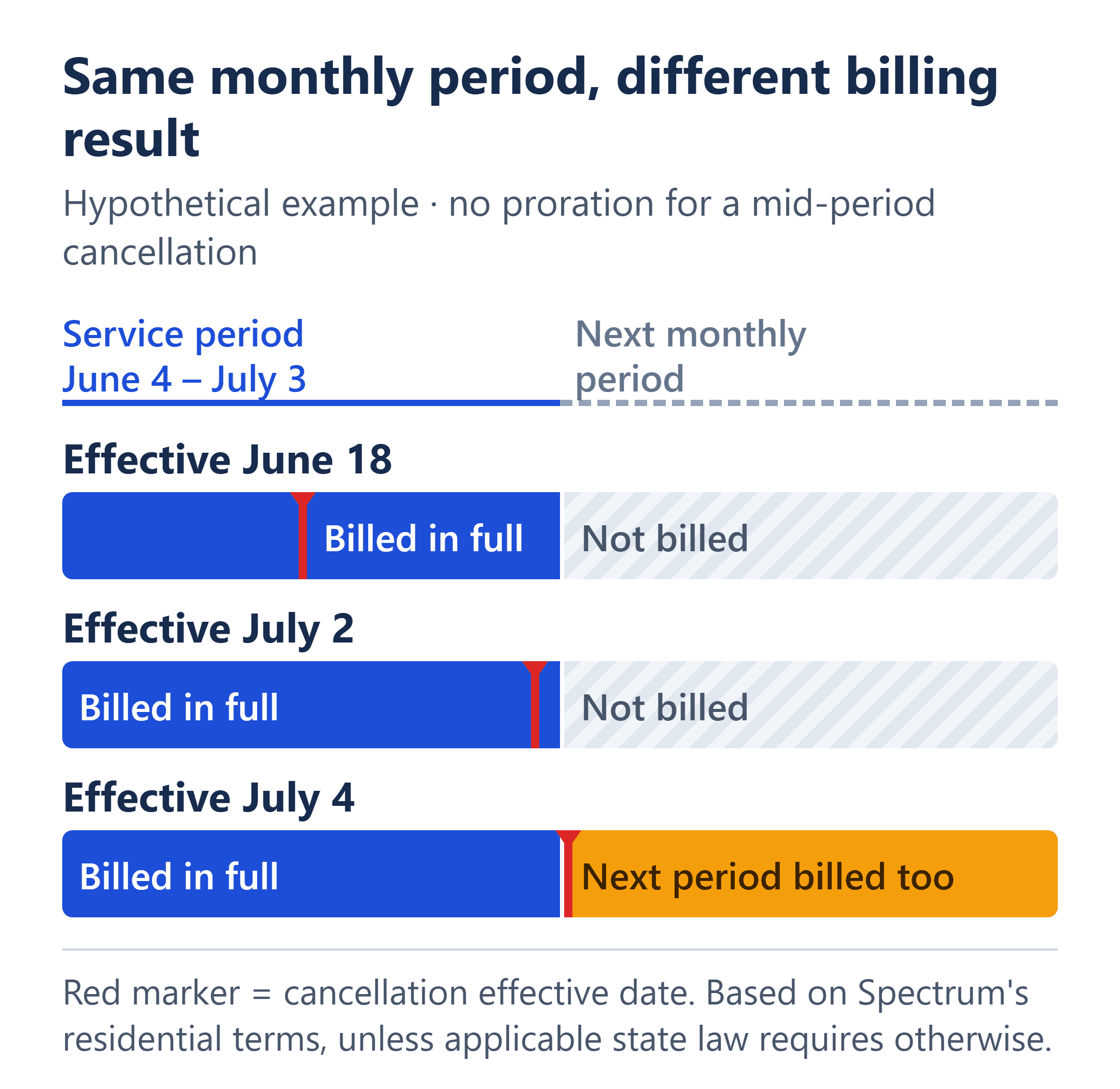
That’s why I would pay far more attention to the end of the service period than to how many unused days are left when switching providers.
Spectrum’s Residential General Terms and Conditions establish both rules, subject to applicable law.
There’s an important exception: some states require prorated final bills. Maine, which we’ll cover below, has specific protections for cable TV and wireline broadband customers.
Where do you find your actual dates?
Open your latest Spectrum statement.
Spectrum’s published sample bill identifies the service period using wording such as:
Service from Apr 13 – May 12
Look for the equivalent date range on your own bill. You can access statements through Spectrum.net or the My Spectrum App.
Don’t assume your service period ends on the last day of the calendar month. Spectrum says its statement cycle begins on the first day of your service.
The date on your statement—not the example above—is the one you need to work from.
One Question I’d Ask Before Ending the Cancellation Call
There is a distinction that’s easy to miss: the day you contact Spectrum and the day your service actually stops aren’t necessarily the same thing.
Spectrum’s residential terms list two methods for requesting termination:
- Call 855-757-7328, the number specified in those terms.
- Send written notice on paper to Spectrum, 2 Digital Place, Floor 4, Simpsonville, SC 29681.
Spectrum’s cancellation help page also tells customers to sign in to view their cancellation options. The available options depend on what the account actually offers; don’t assume there’s a universal online cancellation button.
For phone requests, Spectrum’s terms say notice counts from the date its records show it received your call. They also say a subscriber-requested termination becomes effective after Spectrum receives the request.
That makes the effective date worth confirming instead of assuming.
Here’s what I’d ask:
“My statement shows that my current service period ends on [date]. What effective cancellation date will be recorded, and what date will my connection actually stop? Can you confirm both?”
Those are two separate questions for a reason.
You want to avoid accidentally entering another billing period. But you might also need the old connection to keep working until your new internet is fully installed.
Spectrum’s terms require payment through the end of the current monthly period; that doesn’t establish that service will remain active through every day you’ve paid for.
Don’t leave the request until the last day and assume everything will be processed exactly when you intend.
Ask whether Spectrum can set the disconnect date you need. Confirm what is actually scheduled, and save whatever confirmation you receive.
One more useful distinction: Spectrum’s current residential broadband disclosure lists an early termination fee of $0.00 for internet service. That doesn’t eliminate the final monthly charge or equipment-return obligations. If you accepted a separate offer with its own commitment, check those offer terms as well.
The Router on the Counter Is a Second Deadline
Canceling your service doesn’t finish the job.
Spectrum’s residential terms require you to return its equipment within 10 days of termination. If you don’t, the company can charge you according to its schedule for unreturned equipment.
Notice where that countdown starts: termination, not necessarily the last day printed on your earlier statement.
For example, if you’re trying to coordinate an internet switch, don’t assume you can keep the rented modem until the end of the paid billing period and then start counting another 10 days.
Confirm the termination date and calculate your return deadline from that date.
Spectrum’s equipment-return instructions provide these options:
Spectrum Store: Bring your equipment to a store and keep the receipt showing what was returned and when.
The UPS Store: If there isn’t a Spectrum Store nearby, Spectrum allows returns through The UPS Store. Its post-disconnection guidance says to contact Spectrum before using UPS. Keep the shipping receipt.
Home shipment return kit: If you can’t visit either location, contact Spectrum to request a return kit.
Remember the power supplies that came with your equipment.
There is also a fiber-service exception: Spectrum says customers should leave the Spectrum Optical Network Unit (SONU) modem and its specified power supply connected at the premises rather than return them. Hawaii has its own equipment-return process.
What if the equipment never gets returned?
Spectrum publishes these internet equipment charges in its broadband disclosure, revised October 12, 2026:
| Unreturned internet equipment | Published charge per unit |
|---|---|
| Modem (wired and wireless) | $90.00 |
| Wireless router | $90.00 |
| Spectrum WiFi extender | $60.00 |
These are published equipment categories, not a personalized inventory of your household. Don’t assume a particular model falls into a category without checking.
The disclosure doesn’t establish the charge for every TV receiver or DVR. Spectrum’s rate card depends on the service address, so check the applicable schedule or ask Spectrum what your own equipment would cost if not returned.
You can also review its official equipment-return instructions.
The practical takeaway is simple: an old router left in a moving box isn’t necessarily harmless just because the internet account is closed.
And keep your return receipt. It’s your record of what you handed back.
If another household account you’re closing is with Xfinity, its equipment clock runs under its own terms, so it helps to read canceling Xfinity: no early termination fee on current internet plans, but 10 days to return the equipment.
If You Live in Maine, Don’t Assume the Nationwide No-Proration Rule Applies
Here’s where the answer changes.
Spectrum’s general terms recognize that state law can restrict its no-proration policy.
Maine provides a particularly important example because it has separate laws governing cancellation credits for cable TV and wireline broadband internet.
Under Maine Title 30-A, §3010, a covered cable provider must give a proportional credit or rebate for the days of the monthly billing period after cancellation if the subscriber requests cancellation three or more working days before the end of the billing period.
Maine’s Attorney General reported in January 2023 that Spectrum had been automatically prorating final cable bills under that law since February 2022.
For wireline broadband internet, Maine Title 10, §1500-U provides a similar pro rata credit when the customer requests cancellation at least three working days before the billing period ends.
There’s an additional condition for broadband: a customer who fails to return the provider’s internet equipment isn’t eligible for that cancellation credit.
These are separate statutory rules. The broadband equipment condition shouldn’t be automatically applied to the cable TV credit.
If you’re a Maine customer, I’d specifically ask which cancellation credit applies to your services, make the request within the statutory timeframe, and check the cancellation-credit notice on your bill.
For customers elsewhere, don’t assume Maine’s rules apply to your account. Check your state’s consumer protection or utility regulator if you believe a local proration requirement changes Spectrum’s standard policy.
What to Check After the Internet Stops Working
There’s a tempting moment after a cancellation: the modem is gone, the new internet works, and you stop thinking about Spectrum entirely.
I’d keep the account on my calendar for one more billing cycle.
Spectrum says it sends a final statement during the next billing cycle after the disconnect is processed. That statement can include outstanding charges. If equipment remains unreturned, another statement may follow.
Read the final statement against three things you’ve already collected:
- Your service-period end date: Was the cancellation effective before another monthly period began?
- Your cancellation confirmation: Does the recorded date match what you were told?
- Your equipment-return receipt: Does your account reflect what you returned?
If an unexpected charge appears, contact Spectrum with those records rather than assuming every post-cancellation charge is automatically invalid.
Spectrum’s current terms also require customers disputing statement charges to contact the company within the applicable deadline, which can be affected by law. Don’t ignore an unfamiliar final bill.
If Spectrum won’t fix a charge you believe came after your cancellation took effect, the next steps are laid out in how to ask for a refund, dispute a charge after canceling, and stop the next one.
According to Spectrum’s post-disconnection guidance, former customers can generally continue signing in to Spectrum.net or the My Spectrum App for 60 days after disconnection, subject to different arrangements for retained streaming services.
Use that access to save statements and check outstanding balances.
If you have Spectrum voicemail, save important messages before disconnection; Spectrum says voicemail access ends on the disconnect date.
Before You Cancel, Get These Three Things in Writing—or Save a Record of Them
If I were preparing to cancel a Spectrum residential internet account, I wouldn’t start by guessing which day of the month is cheapest.
I’d start with the statement.
Write down the end of the current service period. Ask Spectrum for the effective cancellation date and the disconnect date. Make sure you understand whether another monthly period will be charged.
Then identify every piece of Spectrum-owned equipment you have, return what Spectrum requires within 10 days of termination, and save the receipt.
Finally, read the actual final statement.
If state law requires proration, as it may for qualifying Maine services, pursue the credit under that state’s conditions instead of accepting the general nationwide rule as the final answer.
The point isn’t to find a magical cancellation date. It’s to avoid paying for another service period you didn’t intend to start—and to make sure an unreturned router doesn’t become a separate bill.
Source and scope note: Based on Spectrum’s residential terms, broadband pricing disclosure (revised October 12, 2026), official support materials, and the cited Maine statutes, checked October 16, 2026. This article concerns cancellation of an entire residential Spectrum Internet, TV or Home Phone account on monthly billing. Spectrum Mobile, partial bundle changes, service transfers, seasonal holds, and the separate terms of Spectrum’s 30-Day Money-Back Guarantee may require different treatment. Always check the terms applying to your own account.