
There’s $11.40 left on a restaurant gift card from a holiday dinner.
In California, that $11.40 can come back as cash. Since April 1, 2026, a gift card for one store or restaurant brand with less than $15 left has to be paid out for its balance when you ask, in currency or as a check. The line was $10 before that, and an older card may still say $10 on the back. The law says under $15.
Not every card qualifies. Visa, Mastercard and Amex gift cards that work at unrelated stores are generally outside the rule, and so are free promotional cards with a printed expiration date. With $15 or more on a covered card, spending part of it first brings the balance under the line.
“Less Than $15” Leaves Out a Card at Exactly $15.00
The rule is one sentence in California Civil Code §1749.5: “a gift certificate with a cash value of less than fifteen dollars ($15) is redeemable in cash for its cash value.” It took effect April 1, 2026, replacing a $10 line. The payout is on request. You ask, and the business pays the balance.
I noticed that the amended text, and the law-firm alerts written about it for retailers, put the whole line on one small word, “less.” A card with $14.99 left qualifies, and a card with exactly $15.00 doesn’t. Spend anything at all on that one, say a $2.50 pair of socks at the clothing store it came from, and the $12.50 left is yours to ask for.

Two things decide it: the balance to the cent and the kind of card.
The card in your hand may disagree. Cards printed before April 1, 2026 can still carry the old “$10” wording, and a 2026 follow-up law lets issuers keep selling them through the end of 2028 without a penalty for that printing alone, if a notice at the register says cards under $15 can be cashed out. ArentFox Schiff’s summary of that law says issuers still have to cash out balances under $15. So a card that reads “balances under $10 redeemable for cash” with $13.75 left is a $13.75 cash-out.
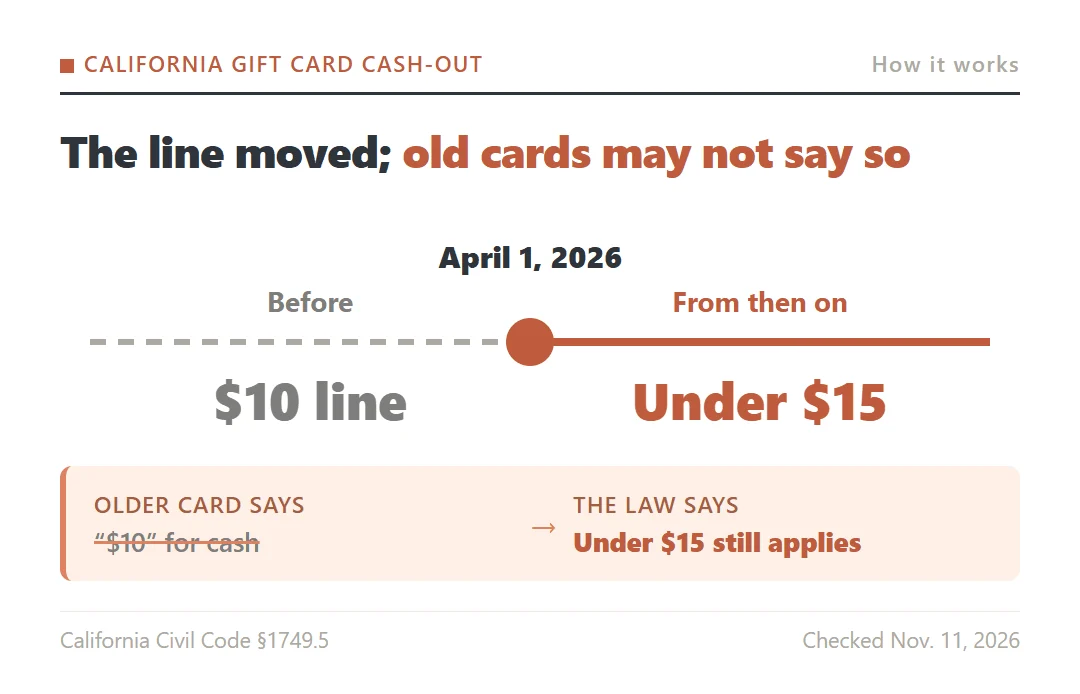
The line printed on an older card and the line in the law can be two different numbers.
Bigger balances work the same way, in two steps. A home-store e-gift card with $38.00 left needs a purchase of at least $23.01 first, because $38.00 minus $14.99 is $23.01. A $25.00 item leaves $13.00, and that’s the amount to ask for. It’s worth doing only if you were going to buy something there anyway, and the store may ring up the purchase and the cash-out as two separate transactions.

Spend the balance below $15 first, then ask for whatever is left.
Which Gift Cards California’s Rule Covers
The definition in §1749.45 counts gift cards and electronic gift cards. It reaches a card for one store or restaurant brand, or for a company’s sister brands, which takes in both the restaurant card and the home-store e-gift card above.
Cards usable at many unrelated stores are the main exception. A Visa, Mastercard or Amex gift card with $6.00 left is generally outside the rule, and the exclusion turns on the expiration date being printed on the card. What happens to that kind of balance falls under a different law, and the post on what happens when a Visa gift card expires picks it up from there.
Free cards are the other one to check this season. A “$10 bonus card” handed out free with a Black Friday purchase is outside the rule when its expiration date is printed in capital letters on the front. That printing is the condition, so look at the front before assuming either way. Cards donated to a charity that say they’re “not redeemable for cash under California state law” are out too, and a few narrower kinds of certificates have exceptions of their own.
All of this is California law, for cards sold for use in California. Other states have their own rules.
Can you cash out this California gift card?
Enter what's left on the card and pick the kind of card. The defaults are the $11.40 restaurant card above.
If your result doesn't match your bill or notice, check the exact figure on California Civil Code §1749.5. Rules as of 2026-11-11
Show the breakdown and basis
California Civil Code §1749.5 and §1749.45, checked Nov. 11, 2026. A covered card with a balance less than $15.00 is paid out for that balance when you ask, as currency or a check (a bank transfer only if both sides agree). At $15.00 or more, spend at least the balance minus $14.99 first. Multi-store cards and free promo cards are excluded when their expiration date is printed on the card.
Values are calculated in your browser and are not saved or sent anywhere.
At the Counter, and Where to Go If the Answer Is No
Ask wherever the card is used. The law counts currency and a check as cash. A bank transfer or a credit to a phone account is allowed only if you and the business both agree to it.
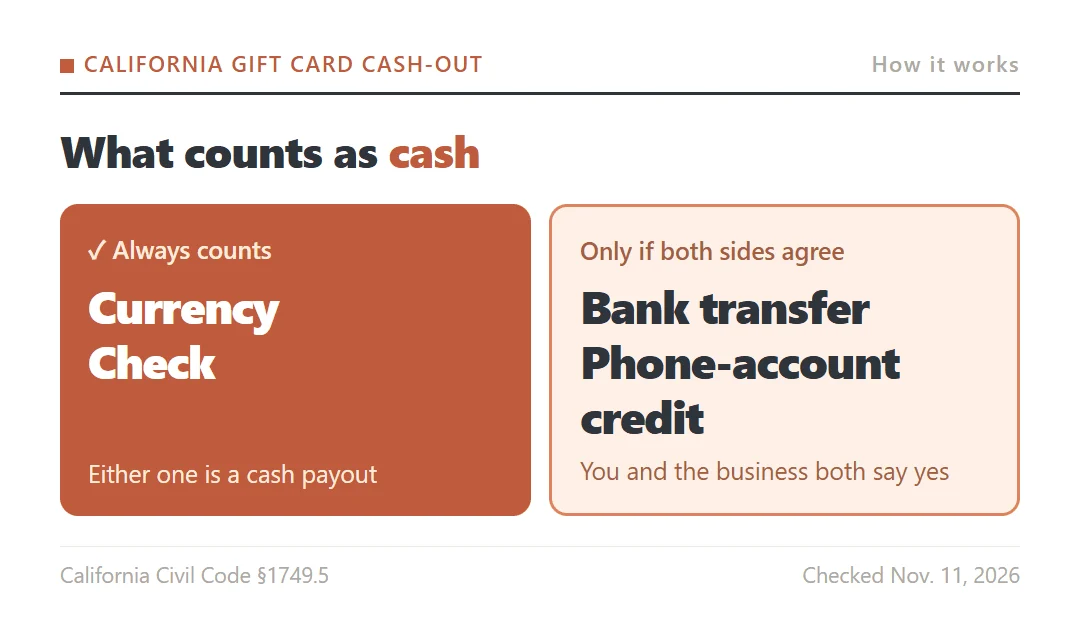
Currency and a check always count; the other two need both sides to say yes.
Some companies send you to a form instead of the register. Chipotle’s cash-back page covers balances of “less than $10 ($15 in California)” and asks for a mailing address that isn’t a PO box. It pays “via bank transfer or check,” with Customer Care replying in about 10 business days. That’s one company’s process, not a rule for every store.
Chipotle built that page as part of a settlement. A case led by the Ventura County District Attorney over cards with less than $10 left ended in a $246,000 settlement with the chain, which has more than 500 California stores. The details are in a Los Angeles County consumer affairs release from October 2025. The company denied wrongdoing.
If a cashier says no, ask for a manager and name the statute, California Civil Code §1749.5. If the answer is still no, a complaint can go to your county district attorney’s consumer protection unit. In LA County there’s also the Department of Consumer and Business Affairs at 800-593-8222, and from anywhere in the state, the California Attorney General. A complaint doesn’t guarantee the balance comes back, but district attorneys and LA County’s consumer affairs office are the ones who brought the Chipotle case.
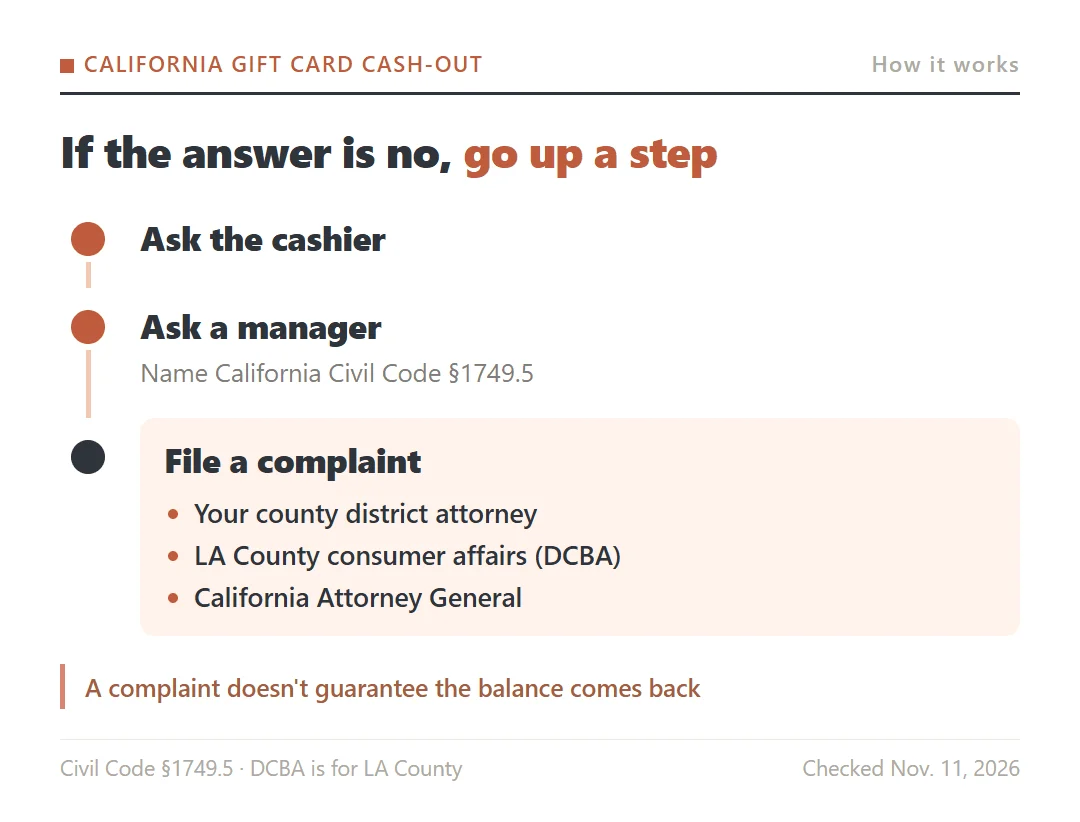
Cashier first, then a manager, then a consumer protection office.
The request at the counter is two sentences.
“This card has $11.40 left, and under California Civil Code section 1749.5 a balance under $15 is redeemable in cash. Can you pay it out to me?”
Photos and icons in this post are illustrations made for explanation; they do not show real places, products or people.