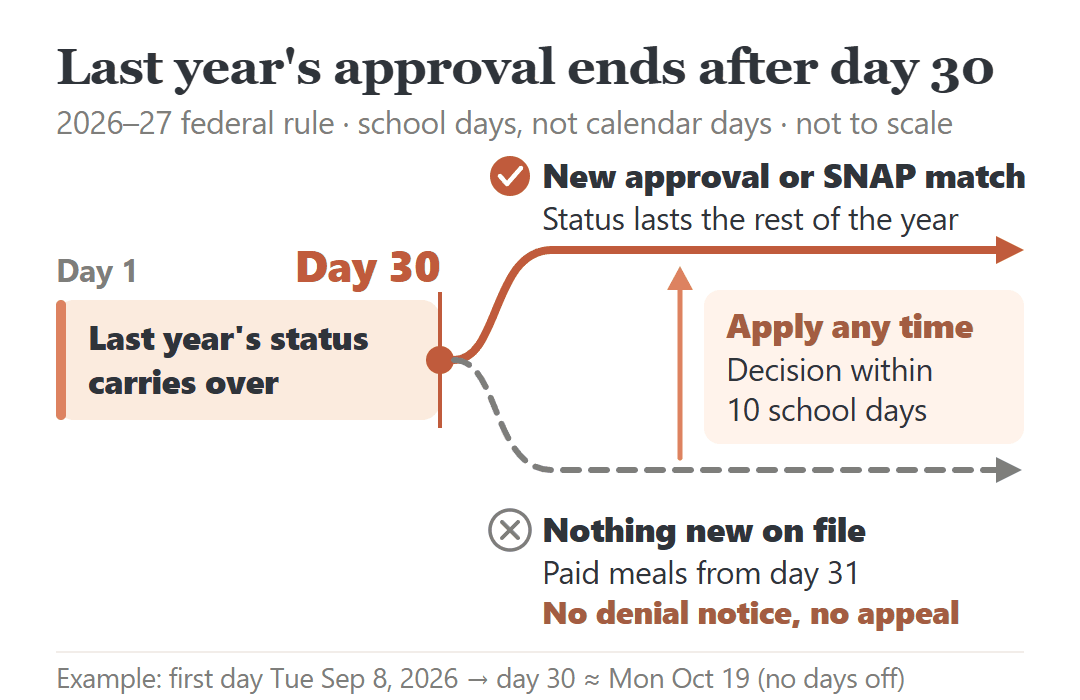
Picture a school district whose first day was Tuesday, September 8, 2026, with no days off since. Count 30 school days and you land on Monday, October 19. That’s a hypothetical calendar, not your district’s, but a date like that decides whether last year’s free lunch is still on your child’s account.
Under the federal rule, last year’s free or reduced-price status carries over only for the first 30 school days of the new year. If no new application has been approved and your child hasn’t been matched through SNAP-type records by then, meals switch to the paid price. There’s no denial letter and no appeal, because no decision was made this year. The first sign can be a negative lunch balance.
For 2026–27, a family of four qualifies for free school meals with gross income at or below $42,900 a year, and for reduced-price meals at or below $61,050 (48 contiguous states and DC). For a family of three, the lines are $35,516 and $50,542. Any child in a household getting SNAP, TANF or FDPIR qualifies for free meals automatically, with no income check.
And there’s no enrollment window to miss: you can apply any time during the school year, and the school has to decide within 10 school days of receiving your application.
Before You Count Anything, Check Whether Your Child Is Already Covered
Two groups can skip the income math entirely.
If anyone in your household gets SNAP, TANF or FDPIR, every child in the household qualifies for free meals. Schools are required to match SNAP records directly, so your child may already show as free. If not, you can put the SNAP, TANF or FDPIR case number on the application.
Children who are in foster care, homeless, migrant, runaway or enrolled in Head Start also qualify for free meals automatically. If your child isn’t showing as free, ask the school office.
One more check. If your school already serves free breakfast and lunch to every student (some high-poverty schools do this through USDA’s Community Eligibility Provision, and some states run their own programs), the application won’t change what your child pays for meals. The school may still ask families for an income form for other reasons, so check with the school before you skip it.
Find Your Household’s Row in the 2026–27 Table
Household size means everyone living together as one economic unit, related or not. It’s not just you and the child in school. If your setup is unusual, such as shared custody or a roommate, ask the school how to count it.
Income means gross income: the amount before taxes, Social Security, insurance premiums and other deductions, not what lands in your bank account. It includes wages, net self-employment income, child support or alimony you receive, unemployment, Social Security, pensions and other cash income. USDA’s notice has the full list.
| Household size | Free meals (gross a year, at or below) | Reduced-price meals (gross a year, at or below) |
|---|---|---|
| 1 | $20,748 | $29,526 |
| 2 | $28,132 | $40,034 |
| 3 | $35,516 | $50,542 |
| 4 | $42,900 | $61,050 |
| 5 | $50,284 | $71,558 |
| 6 | $57,668 | $82,066 |
| 7 | $65,052 | $92,574 |
| 8 | $72,436 | $103,082 |
| Each additional person | +$7,384 | +$10,508 |
If your income is exactly on a line, it counts: the test is “at or below.” Monthly, twice-a-month, every-two-weeks and weekly versions of the same lines, plus the higher Alaska and Hawaii lines, are in USDA’s 2026–27 Income Eligibility Guidelines.
Paycheck or Yearly Total: Which Number the School Compares
This is the step where rough math at the kitchen table can give the wrong answer, and the actual rule is short.
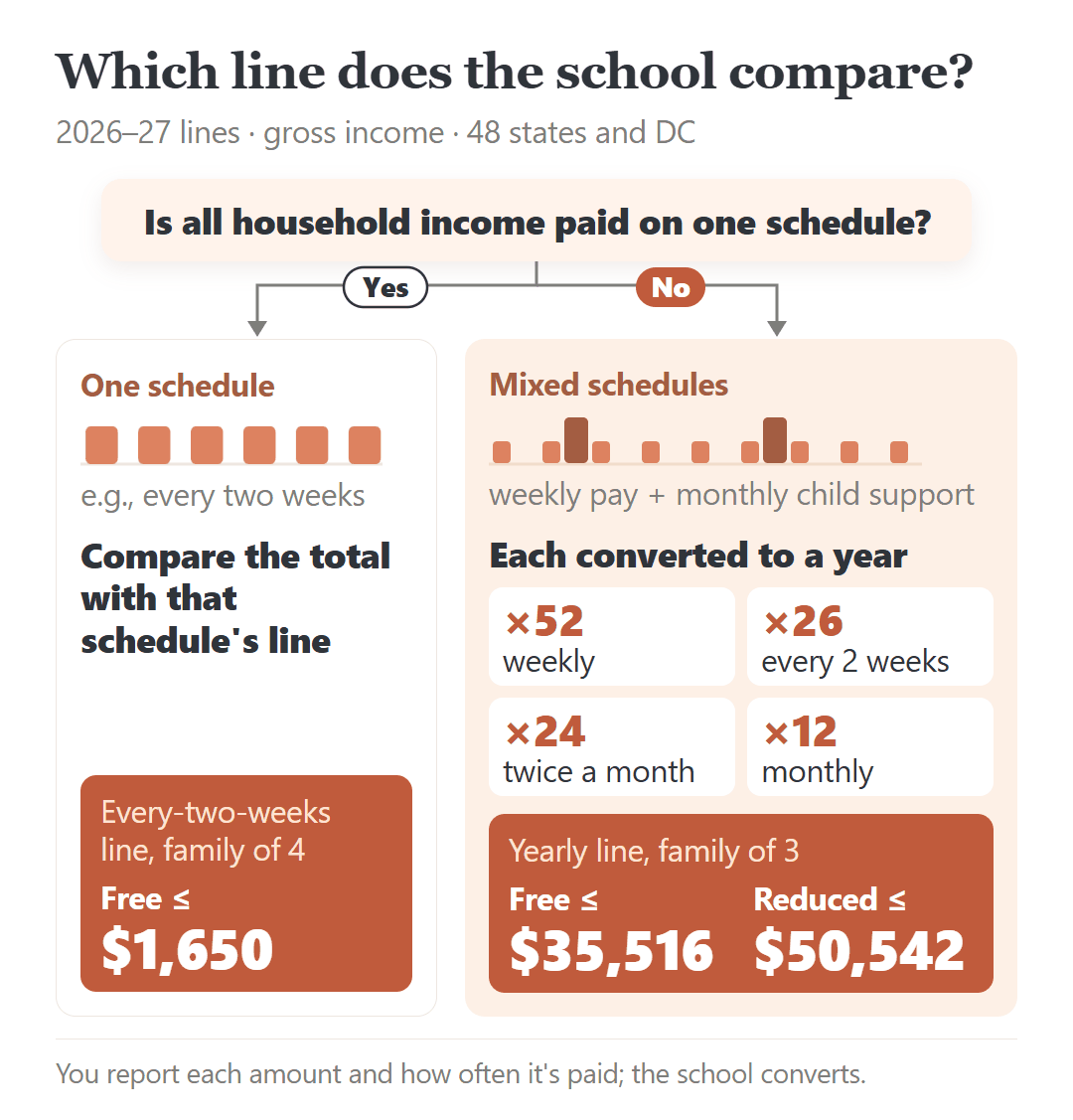
If all your household’s income comes on the same schedule, the school adds it up and compares it with that schedule’s column: weekly pay against the weekly line, every-two-weeks pay against the every-two-weeks line.
If income arrives on different schedules, say weekly pay plus monthly child support, the school turns every amount into a yearly figure: weekly × 52, every two weeks × 26, twice a month × 24, monthly × 12. Then it compares the total with the annual line. Schools aren’t allowed to use shortcuts like 4.33 weeks a month.
Your part is smaller. On the application, report each amount and how often it’s paid. You don’t convert anything. The school uses your most recent income; if last month wasn’t typical of your year, tell the school.
Household A: one paycheck, one column
Household A is hypothetical: four people, one parent paid every two weeks, $1,600 gross per paycheck, no other income. The 2026–27 every-two-weeks free line for four is $1,650. $1,600 is under it, so this household qualifies for free meals.
Household B: two schedules, one yearly total
Household B, also hypothetical: three people, a parent earning $700 gross a week, plus $400 a month in child support. The school annualizes: $700 × 52 = $36,400, plus $400 × 12 = $4,800, for $41,200 a year.
That’s above the $35,516 free line for three and below the $50,542 reduced-price line, so Household B gets reduced-price meals.
Why “times four” can flip the answer
Change Household B slightly, still hypothetical: $660 gross a week plus $100 a month in child support. Multiplying the weekly pay by four gives $2,640, plus $100 is $2,740 a month. That’s under the $2,960 monthly free line for three, so it looks like free meals.
The school’s method gives $660 × 52 + $100 × 12 = $35,520 a year. That’s $4 over the $35,516 free line, so the result is reduced price, not free. This is why I’d list each amount and its schedule exactly as paid and let the school do the conversion.
If Last Year’s Free Lunch Stopped This Fall
USDA’s Eligibility Manual is blunt about what happens when the carryover runs out without a new determination. The school “cannot send a notice of denial,” and the household “does not have a right to appeal,” because no decision was made this school year. Schools are encouraged to send reminders before the cutoff, but they aren’t required to.
To find your own day 30, start from your district’s first day and count school days only, skipping holidays and days off. In a hypothetical district that started Wednesday, August 12, 2026 and closed for Labor Day, day 30 fell around Wednesday, September 23. Your district calendar, or a carryover reminder if the school sent one, gives the real date.
Whichever date applies, the next step is the same: apply now. You can apply any time during the school year, including after a job loss, a pay cut, a new baby or someone joining the household. The school must decide within 10 school days of receiving the application and let you know.
Applying sooner also matters for money. Approval normally starts on the date the school decides. Some districts instead start it on the date they received a complete application. Those districts must refund what was paid for meals in the gap and forgive meal debt from it. Meals charged before you applied aren’t erased by approval.
Once approved, the status lasts the rest of the school year and carries into the first 30 school days of next year. A raise next month or leaving SNAP in December doesn’t end it, and you don’t have to report either. During the year, the school can lower benefits only after verification or an official program review, or if you ask in writing.
If you’re not sure where your child stands, this is the message I’d send the school’s food service office:
“My child [name, school] had [free / reduced-price] meals last year. Is that status still active for 2026–27, or has the 30-school-day carryover ended? If I submit a new application today, does approval start on the date you receive a complete application, or on the date it’s approved?”
What Approval Is Worth at Your School’s Prices
Reduced price can’t be more than 40¢ for lunch and 30¢ for breakfast, and some states charge less or nothing. Free is $0. Paid prices are set by each district, so the size of the gap depends on your school’s menu price.
Here’s a hypothetical school to show the scale: paid lunch $3.50, paid breakfast $2.00, 180 school days. Full price for both comes to $990 a year per child ($630 lunch plus $360 breakfast). Reduced price at the federal maximum is 180 × ($0.40 + $0.30) = $126. Free is $0. These are example prices, not your district’s.
For your own figure, take your school’s paid lunch price (plus the breakfast price, if your child eats breakfast at school) and multiply by the school days left this year. That’s what paid meals would cost per child from here.
Your Order of Steps Before the Next Lunch Charge
- Check whether your school serves free meals to every student. If it does, meals cost the same either way.
- If anyone in the household gets SNAP, TANF or FDPIR, have the case number ready. Your children qualify for free meals without an income check.
- Otherwise, count everyone in the household and find that row in the 2026–27 table.
- List each source of gross income and how often it’s paid. Don’t convert it yourself.
- Apply through your school district, online or on paper. One application usually covers every child in the household.
- Look for the decision within 10 school days, and keep the approval letter.
If the school later picks your application for verification, which it does for a small sample each fall, send the proof it asks for. If you don’t, the benefit can be reduced.
What stands out to me in these rules is who ends up paying. It’s often not families over the line. It’s families who were approved last year, assumed the approval rolled over, and found out from the lunch account. If that might be you, apply this week instead of waiting for a letter that may never come.
Keep that approval letter where you can find it. A school lunch program letter showing your child’s name and school is also one of the proofs Amazon accepts; here’s who qualifies for Amazon Prime Access and how to prove it.
Sources: USDA’s 2026–27 Income Eligibility Guidelines (linked above), 7 CFR Part 245, USDA’s Eligibility Manual for School Meals, and USDA’s Community Eligibility Provision page. Checked October 2026; income figures are USDA’s 2026–27 guidelines for the 48 contiguous states and DC.