Before you call T-Mobile to cancel Home Internet, pull up your latest bill and find the date your billing period ends. Say it ends on the 20th. That’s a made-up date for illustration, but the rule behind it is T-Mobile’s.
T-Mobile says cancellations are future dated and typically take effect at the end of your current billing cycle, and you’re responsible for charges through that date. Call on the 3rd or on the 19th and service still runs to the 20th. Call on the 21st and it runs to the 20th of the next month, and you pay for that cycle too.
The second thing to know is stranger. T-Mobile’s own support pages give three different deadlines for sending the gateway back: 14 days on one page, 30 days on another, and 45 days on two more.
T-Mobile 5G Home Internet has no annual contract and no early termination fee, but the gateway is on loan and has to go back. You’ll typically pay through the end of the billing cycle you cancel in. For the gateway and any mesh Wi-Fi extender, plan on the shortest window T-Mobile publishes, 14 days, and ask for your return-by date on the cancellation call. Miss the deadline and T-Mobile can charge a non-return fee of up to $370 plus tax, based on what your device costs to replace.
This covers T-Mobile 5G Home Internet with a gateway. T-Mobile Fiber, Mint’s home internet, Metro by T-Mobile and Small Business Internet have their own equipment and terms and aren’t covered here.
Find Your Billing Cycle Close Date Before You Call
T-Mobile’s Home Internet plans page says the 5G gateway is included with no monthly equipment fees or annual contracts. So the cost of leaving isn’t a fee. It’s the rest of the billing cycle you cancel in, plus whatever happens to the equipment.
The day you stop using the internet doesn’t change that. The cancellation is dated to the end of the cycle, and T-Mobile’s cancel page says you’re responsible for all charges and usage through the end of your current billing cycle. That makes the cycle close date on your bill the number to work from.
If your Home Internet shares an account with T-Mobile phones, canceling it can change multi-line discounts or promotions, and canceling the entire account makes any remaining device balances due on the final bill. Check those before you call.
Household A: the same cycle, three different call days
Household A is a hypothetical example, not a real customer’s bill. Their billing cycle runs from the 21st to the 20th, and they’ve decided to switch to cable.
If they call on Oct. 3, the cancellation takes effect Oct. 20, and they pay the Sept. 21 – Oct. 20 cycle in full. If they call on Oct. 12, the result is the same. If they wait until Oct. 21, the cancellation moves to Nov. 20, and one more full cycle is billed.
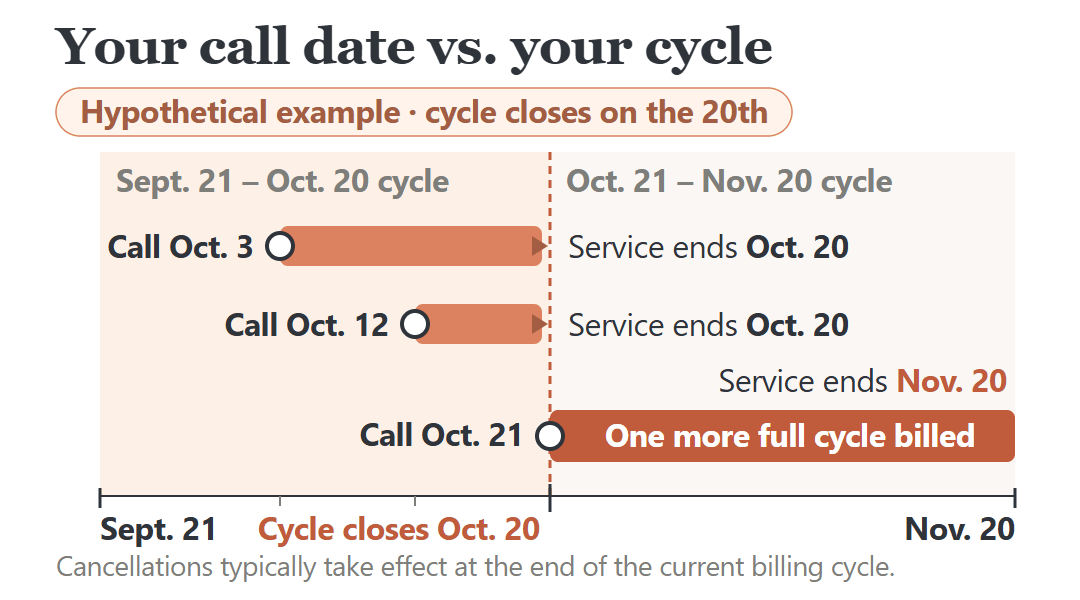
Calling early doesn’t save money, because the cycle is billed either way. Calling one day late costs a whole month. The date you want is the one printed on your bill, not the day the new provider is installed.
Three Return Windows on T-Mobile’s Own Pages, and Why I’d Plan on 14 Days
Here’s what each current T-Mobile support page says about returning Home Internet equipment, as checked Oct. 16, 2026:
| T-Mobile page | Window | What the page ties it to |
|---|---|---|
| Cancel service support | 14 days | Gateway and mesh extender; label emailed after cancellation |
| Return a gateway | 30 days | From starting the return |
| Home Internet account support; 15-Day Test Drive | 45 days | From cancellation |
None of these pages says which one wins, or whether “after cancellation” means the day you call or the day service ends. Guides online tend to repeat just one of the numbers.
With the company’s own pages disagreeing, the shortest window is the only one that’s safe under all of them. So I’d plan on 14 days, ask the rep for the return-by date that applies to your account, and treat that date, not a guide’s number, as the one that counts.
“Before we finish: what is the exact date my gateway and mesh extender need to be back by, and does that count from today or from the day service ends? Can you note that date on my account and confirm the return label is going to this email address?”
Household A shows why the start date matters. If a 14-day clock ran from an Oct. 3 call, the gateway would be due Oct. 17, three days before their internet ends. Calling Oct. 12 instead and shipping the gateway on Oct. 20, the day service ends, keeps the return inside 14 days of the call, 30 days of the return starting and 45 days of the cancellation.
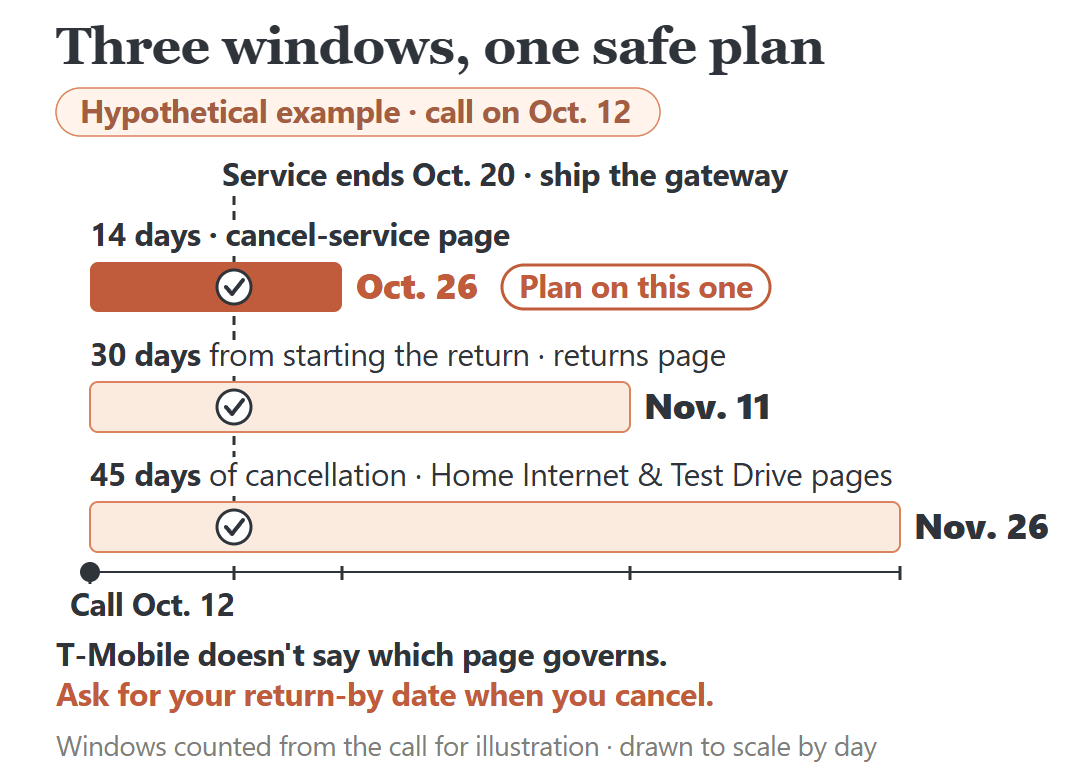
That timing is an example, not a best day to cancel. Your own cycle date and the return-by date the rep gives you decide yours.
What Late, Missing or Damaged Equipment Can Cost
If the equipment doesn’t come back in time, T-Mobile’s cancel page lists a non-return fee of up to $370 plus tax. Its returns page says fees for non-return, damage and missing parts all depend on the replacement cost of the specific device, so $370 is a ceiling, not a set price.
Returned equipment is inspected for things like screen damage, physical damage, tampering and liquid damage. On the damage charge, two T-Mobile pages give different figures:
- The Home Internet account support page lists a one-time $79 charge, shown on the bill as “INTERNET EQUIP DAMAGE CHARGE,” added within one to two bill cycles.
- The gateway returns page says damaged or inoperable devices can be charged repair cost up to the device’s replacement cost, which it caps at $370.
I wouldn’t try to guess which one applies to you. The way to avoid both is the same: send back everything T-Mobile gave you, in working order.
Household C: a closet and a cracked display
Household C is also hypothetical. Their gateway and mesh extender sit in a closet past the deadline, and T-Mobile can bill a non-return fee of up to $370 plus tax, based on each device’s replacement cost. If they had returned the gateway with a cracked display instead, the Home Internet page’s terms point to a $79 damage charge, while the general returns page allows up to the replacement cost.
Sending the Gateway Back So the Return Is on Record
After you cancel, T-Mobile emails a prepaid return label. Its returns page says labels usually arrive within 24 hours, so check junk and spam if you don’t see it. Returns of gateways are free of shipping and restocking charges.
Pack the box with:
- the gateway
- any mesh Wi-Fi extender, which has the same deadline as the gateway
- the power adapter, if you still have it
- the Return Authorization Slip, placed inside before you seal it
Attach the label and drop the box in the mail or at a UPS store. If you’d rather hand it over in person, T-Mobile says Home Internet customers can return the device at a T-Mobile store, even if a mail return was already started.
Whichever way you send it, keep the tracking number or a drop-off receipt, and take a photo of what went in the box. That’s your proof if a fee shows up later.
Canceling Inside the 15-Day Test Drive
New customers on a qualifying Home Internet line get T-Mobile’s 15-day Test Drive, one per account. It’s a limited-time offer that T-Mobile says is subject to change.
The detail people miss is when it starts. If you ordered online or by phone, the 15 days start the day you get the notice that your gateway has shipped, not when you plug it in. If you signed up in a store, they start when the account is activated and you take the device home.
Cancel inside that window and T-Mobile applies a one-time bill credit that zeroes out the Home Internet service charges. The plans-page terms add two details: submit the redemption within 30 days of canceling, and allow up to two bill cycles for the credit. The same terms list “timely gateway return” as a requirement.
The gateway still goes back on the same plan as everyone else. A non-return fee isn’t refunded under the Test Drive.
Household B: shipped on the 1st, set up on the 4th
Household B is hypothetical. They ordered online, got the shipping notice on Oct. 1 and set the gateway up on Oct. 4. Their 15 days count from Oct. 1, not Oct. 4.
They cancel on Oct. 13, inside the window. On that call, they ask for the Test Drive credit and the return-by date. Because the credit can take up to two bill cycles to show, they don’t wait to see it: if the rep can’t confirm it’s been applied, they submit the redemption within 30 days of canceling.
“I’m canceling within my 15-day Test Drive. Can you apply the Test Drive bill credit now, and tell me if I need to submit a redemption separately? And what’s the return-by date for my gateway?”
Your Order of Moves, From the Bill Date to the Last Charge
- Find your billing cycle close date on your current bill. New customers: also find the date of your gateway’s shipping notice.
- Call before that close date, close enough to it that you can ship the gateway the day service ends and still be inside 14 days.
- On the call, ask for your return-by date and, if you’re in the Test Drive, the credit.
- Ship the gateway, mesh extender, power adapter and slip as soon as service ends, and keep the tracking number.
- Pay the final bill. If AutoPay is on, it may charge your saved payment method automatically. A credit left on the account may be refunded 30 days after the final bill, and an unpaid balance can go to collections.
- Read the next one or two bills for a non-return or damage charge, and dispute any you see with your tracking number.
The step I’d guard most is the second one. A day late on the call costs a full cycle, and calling too early can leave the gateway due before your internet even ends, if the 14 days count from the call.
If you’re leaving for Spectrum, its own last bill works on dates too. Here’s how Spectrum handles your final bill and equipment return when you cancel, worth knowing before you sign up.
Sources: T-Mobile’s cancel service support, Home Internet account support, 15-Day Test Drive and gateway return pages, and the Home Internet plans page, checked Oct. 16, 2026. T-Mobile’s pages and offers can change, and they disagree on the return window, so the return-by date on your own cancellation is the one to keep. Households A, B and C are hypothetical examples, not real customers or real bills.