Before you open Amazon’s sign-up page, open your wallet, or the drawer where the benefit letters end up.
The proof Amazon asks for to get Prime Access is often something a household already has: a SNAP EBT card, a Direct Express Debit Card, a Medicaid eligibility letter, an SSDI award letter. Whether the one you’re holding works comes down to two things: whether its program is on Amazon’s list, and the date printed on it.
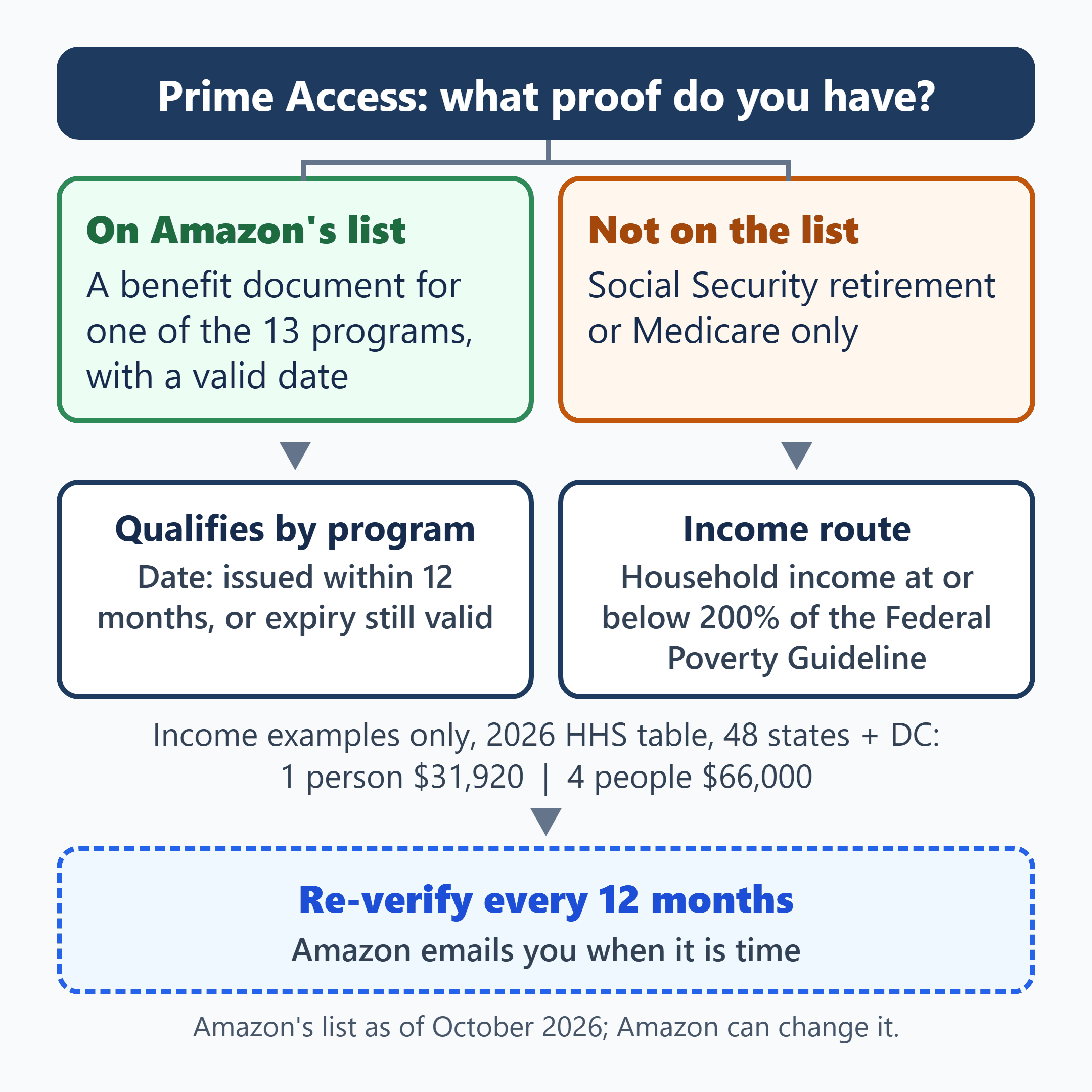
Some benefits people expect to count aren’t on that list by themselves. Social Security retirement benefits and Medicare aren’t among the programs Amazon names, so if those are all you have, the income route is the one to check.
You can qualify for Prime Access in two ways: you’re enrolled in one of the 13 government assistance programs Amazon lists, or your household income is verified at or below 200% of the Federal Poverty Guideline. That’s Amazon’s list as of October 2026, and Amazon can change it. Whatever you upload has to be a legible image showing the beneficiary’s name and either an issue date within the last 12 months or an expiry date that is still valid.
As of October 16, 2026, Prime Access is $6.99 a month and standard Prime is $14.99 a month, both before sales tax, which Amazon charges on Prime in some states. The lower price isn’t a one-time approval: you keep it by re-verifying every 12 months, and Amazon emails you when it’s time.
Match What You’re Holding to Amazon’s List
Look for the benefit your household gets today by name. The right-hand column is the document Amazon names for that program on its Sign Up for Prime Access help page. Plan on exactly that document, not something close to it.
| If you get | Amazon asks for |
|---|---|
| SNAP | Your SNAP EBT number and an image of your SNAP EBT card |
| Medicaid | An image of your Medicaid eligibility letter |
| WIC | An image of the WIC eligibility letter |
| SSI | An image of the complete SSI eligibility letter |
| Federal Public Housing Assistance (FPHA) | A copy of your Housing Choice Voucher (Form HUD 52646) |
| Veterans & Survivors Pension Benefits (VSPB) | A copy of the VSPB Decision Letter |
| SSDI | A copy of your SSDI Award Letter |
| Direct Express Debit Card | An image of your Direct Express Debit Card |
| TANF | An image of your TANF eligibility letter |
| National School Lunch Program (NSLP) | An eligibility letter showing your current participation in the program, with your child’s name and the school name |
| LIHEAP | An eligibility letter that confirms you qualified for LIHEAP |
| Tribal TANF (TTANF) | An image of the Tribal assistance eligibility letter |
| Puerto Rico’s Nutrition Assistance Program (NAP) | An image of the Family Card |
| None of these, but household income at or below 200% of the Federal Poverty Guideline | An income check: either no document upload, with the check based on what you enter, or tax transcripts uploaded on the SheerID website |
Three rows are easy to misread. For Medicaid, the proof is the eligibility letter. For SNAP, it’s the card plus the EBT number. For school lunch, the letter has to show current participation, your child’s name and the school name.
The Date Printed on It Matters as Much as the Program
Having a listed benefit isn’t enough on its own. Amazon’s rule for the image you upload is that it must be legible and show the beneficiary’s name and either an issue date within the last 12 months or an expiry date that is still valid.
So before you start, check two things on the card or letter: that the beneficiary’s name is readable, and which date it shows. A letter that’s older than 12 months and has no valid expiry date doesn’t meet that rule. If that’s what you have, ask the agency that pays the benefit for a current one first, then sign up.
Social Security or Medicare Only? Here’s Where That Leaves You
This is where a lot of households, especially older ones, get a different answer than they expected. The names sound alike, and they don’t lead to the same place:
- SSI (Supplemental Security Income): on the list. The proof is the complete SSI eligibility letter, and Amazon’s help page notes that SSI is different from Social Security and SSDI.
- SSDI (Social Security Disability Insurance): on the list as its own program, with the SSDI Award Letter as proof.
- Medicaid: on the list, with the Medicaid eligibility letter as proof.
- Social Security retirement benefits: not one of the 13 programs by itself.
- Medicare: not one of the 13 programs by itself.
If Social Security retirement or Medicare is all you have, the income route below is still open to you. If you also have Medicaid, use the Medicaid letter. And if your federal benefit payments come on a Direct Express Debit Card, the prepaid debit card the US Treasury offers for receiving them, that card is on Amazon’s list in its own right; the proof Amazon names for it is an image of the card.
No Listed Benefit? Work Out Your Own Income Line
The second way in is household income at or below 200% of the Federal Poverty Guideline. Amazon publishes the percentage, not a dollar figure, so the number is yours to work out: find the guideline for your household size in the HHS poverty guidelines table and double it.
For example, using HHS’s 2026 table for the 48 contiguous states and DC, twice the guideline is $31,920 for one person ($15,960 × 2) and $66,000 for a household of four ($33,000 × 2). Alaska and Hawaii use higher tables, and Amazon’s partner makes the determination, so treat your own figure as a guide, not a ruling.
Amazon’s help page describes two income methods. In one, no document upload is needed and the check is based on the information you enter. In the other, you upload tax transcripts on the SheerID website, and Amazon says it will not receive those documents. On its Prime Access page, Amazon says its secure third-party partner verifies household income based on the information you enter.
What You’d Pay, Next to What You Pay Now
As of October 16, 2026, Amazon’s pages show Prime Access at $6.99 a month. Standard Prime is $14.99 a month or $139 a year. All of these are before sales tax in the states that charge it. Against the monthly price, Prime Access is $8 a month less, before tax.
Prime Access is shown only as a monthly price. If you pay for Prime by the year now, compare $6.99 a month with what you actually pay, not with $14.99.
Amazon says eligible new Prime members get a free 30-day trial before the $6.99 monthly charge begins, and that if you’re eligible for a trial you’re charged automatically for the next membership period when it ends. After that you’re billed monthly on the same day you signed up. Amazon describes Prime Access as offering all the same benefits as the full-price membership, with certain benefits shareable with other adults in your Amazon Family.
Signing Up, or Switching From Regular Prime
Sign-up starts at amazon.com/primeaccess, where you follow the verification steps for your route: the document for your program, or the income check.
If you already pay for Prime, Amazon says you can update your membership to join Prime Access from the same page. If you paid for a year up front, read the terms shown on the Prime Access page before you confirm.
Not every check comes back right away. Amazon says certain verifications take up to seven business days to confirm, that it sends the confirmation by email, and that you automatically have access to all of Prime’s benefits until the verification is complete.
Twelve Months Later, the Proof Question Comes Back
Amazon’s help page says that if you re-verify your eligibility every 12 months, you continue to receive the discount, and that it will email you when it’s time. The same date rule applies again, so the letter that worked this year may not work next year.
If you’re no longer eligible for a plan, Amazon’s Prime terms say it may move your membership to a different Prime plan, that it will notify you before your next renewal, and that you can cancel before the change takes effect.
Put the Card Next to the List Before You Click Anything
If I were applying, the first step wouldn’t happen on Amazon at all. I’d set the card or letter next to the table above and answer two questions: is this program named there, and is the issue date within the last 12 months or the expiry date still valid? Two yeses, and you’re ready to start. A no on the first sends you to the income line; a no on the second sends you to the agency for a current letter.
Then I’d note the month I signed up somewhere I’ll actually see it, because that’s when the proof question comes back.
You can cancel Prime Access at any time. If neither route fits, Amazon points people who don’t qualify to Prime for Young Adults, for ages 18 to 24 or students, or to the standard 30-day Prime trial.
A benefit letter can lower more than one household bill. If a phone or internet bill is next on your list, who qualifies for the Lifeline phone and internet discount in 2026, and why it isn’t a flat $9.25 works through that program’s own rules.
Based on Amazon’s Prime Access pages, Prime terms and help pages, and the HHS 2026 poverty guidelines, checked October 16, 2026. US only. Amazon can change the program list, the proof it asks for and the prices.