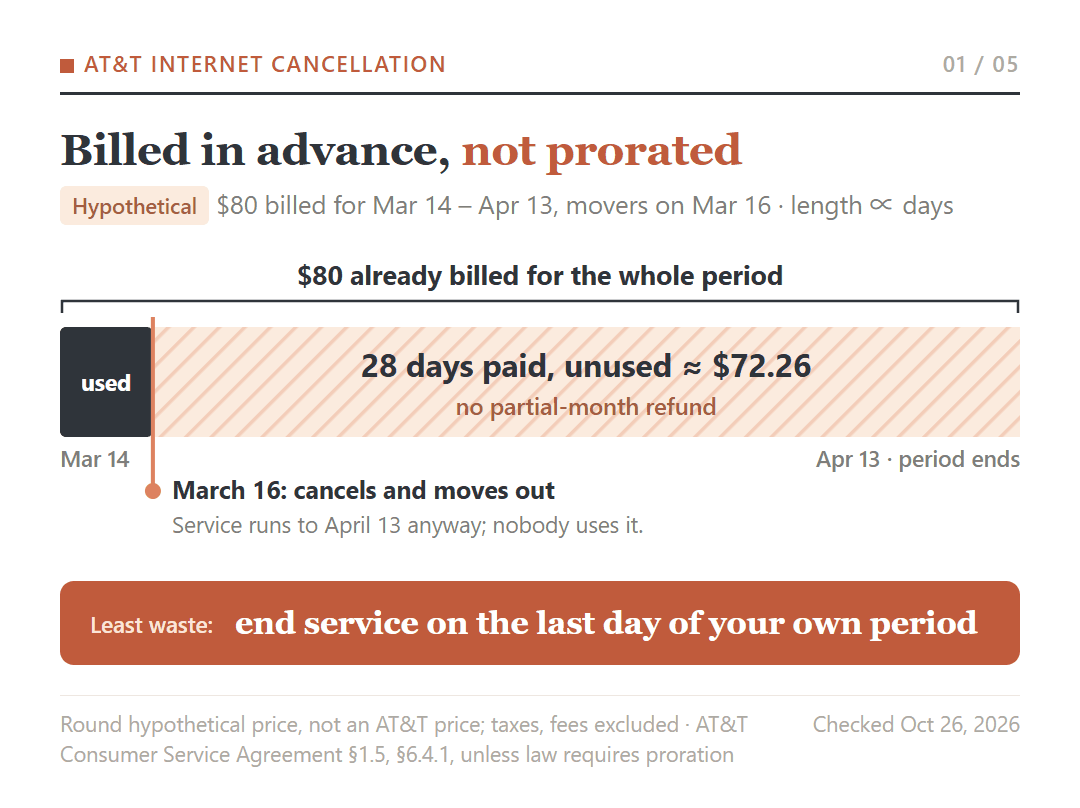
Say your statement shows a service period of March 14 through April 13, and the movers are booked for March 16. (This is a hypothetical calendar, not a real customer’s bill.)
Take a hypothetical household paying a round $80 a month for AT&T home internet (not an AT&T price; taxes and fees left out). If it cancels on moving day, the $80 already billed covers 28 days nobody will use, about $72.26, and AT&T won’t credit any of it back.
That’s because AT&T’s Consumer Service Agreement says that, “unless required by applicable law, there is no proration of charges and you are still responsible for the full month’s payment” even if service ends before the billing cycle does. Internet is also billed in advance, so the bill you already have pays for the period you’re in. The same terms cover AT&T Fiber, AT&T Internet and AT&T Internet Air.
So the date to plan around is the last day of your own current billing period. After service ends, return the gateway within 21 calendar days to avoid a non-return fee ($150 for AT&T Fiber or AT&T Internet, $200 for AT&T Internet Air). Plans AT&T currently sells carry no early termination fee; one applies only if you signed up with a term commitment.
Two Days Past Your Period End Means Paying for a Whole New Month
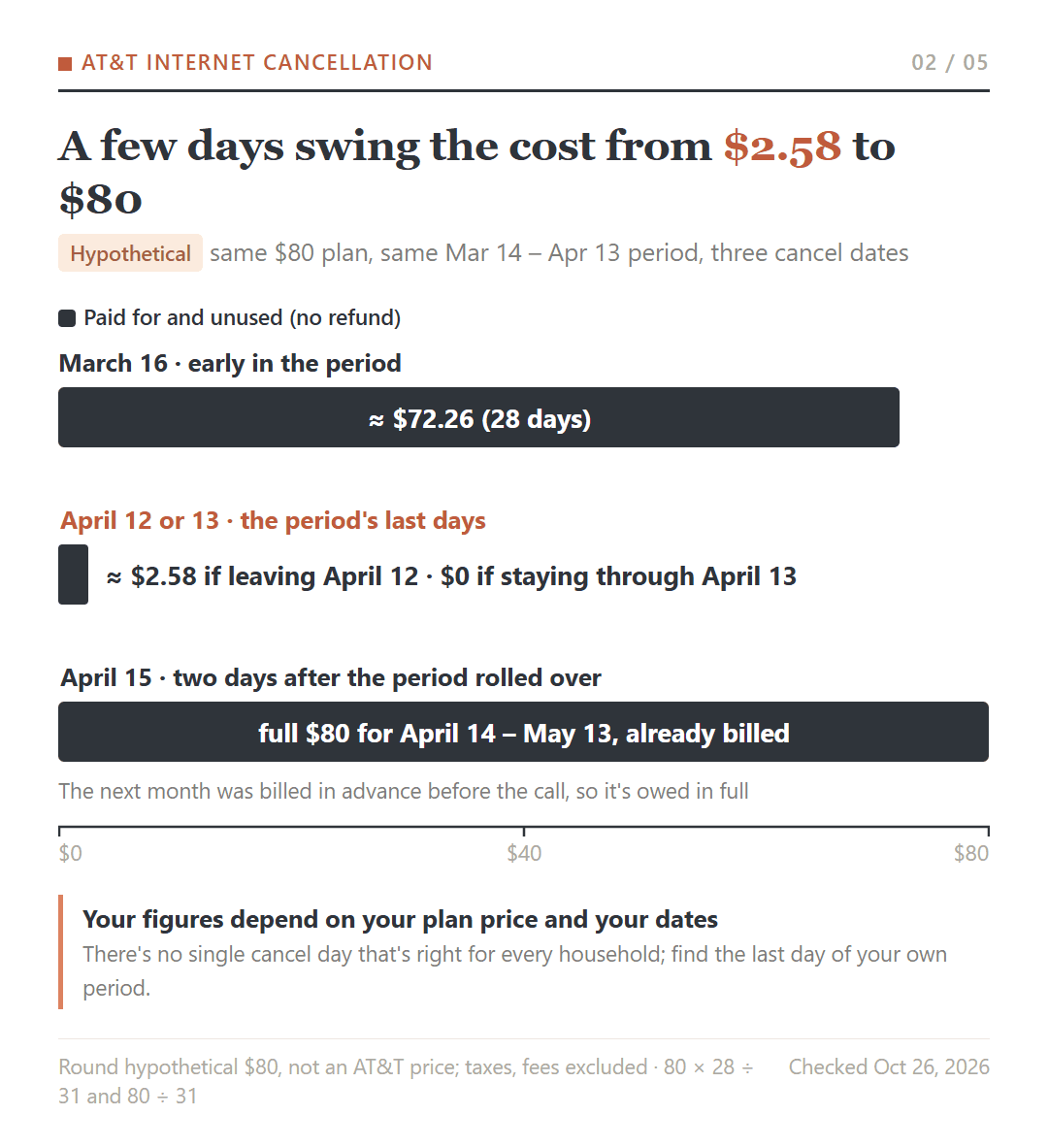
Because AT&T bills each month ahead and doesn’t prorate, the cost of canceling depends on where your date lands inside your billing period. Here is the same hypothetical household, same $80 plan, same March 14 – April 13 period, with three different cancel dates:
- March 16, early in the period: the $80 already billed runs through April 13, so about 28 days, roughly $72.26, are paid for and unused (80 × 28 ÷ 31).
- April 13, the period’s last day: if the household stays through April 13, nothing is wasted; if it leaves April 12, about one day, roughly $2.58, goes unused.
- April 15, two days after the period rolled over: the April 14 – May 13 period was already billed in advance, so the household owes that full $80 for a month it barely used.
Moving the date by a few days swings the cost from a couple of dollars to a whole month. Your own figures depend on your plan price and your dates, so there’s no single cancel day that’s right for every household.
To find your date, look at the service period on your latest AT&T bill or in your account; its last day is your target. AT&T’s terms don’t say whether you can schedule a disconnect for a future date, so ask that on the call instead of assuming it.
What surprised me in AT&T’s terms is where the no-proration sentence lives: not on the internet cancellation policy page, but in section 1.5 of the Consumer Service Agreement, well ahead of the home-internet terms in Section 6. The one exception it makes is where applicable law requires proration.
The Gateway Goes Back; the Box on the Wall Stays
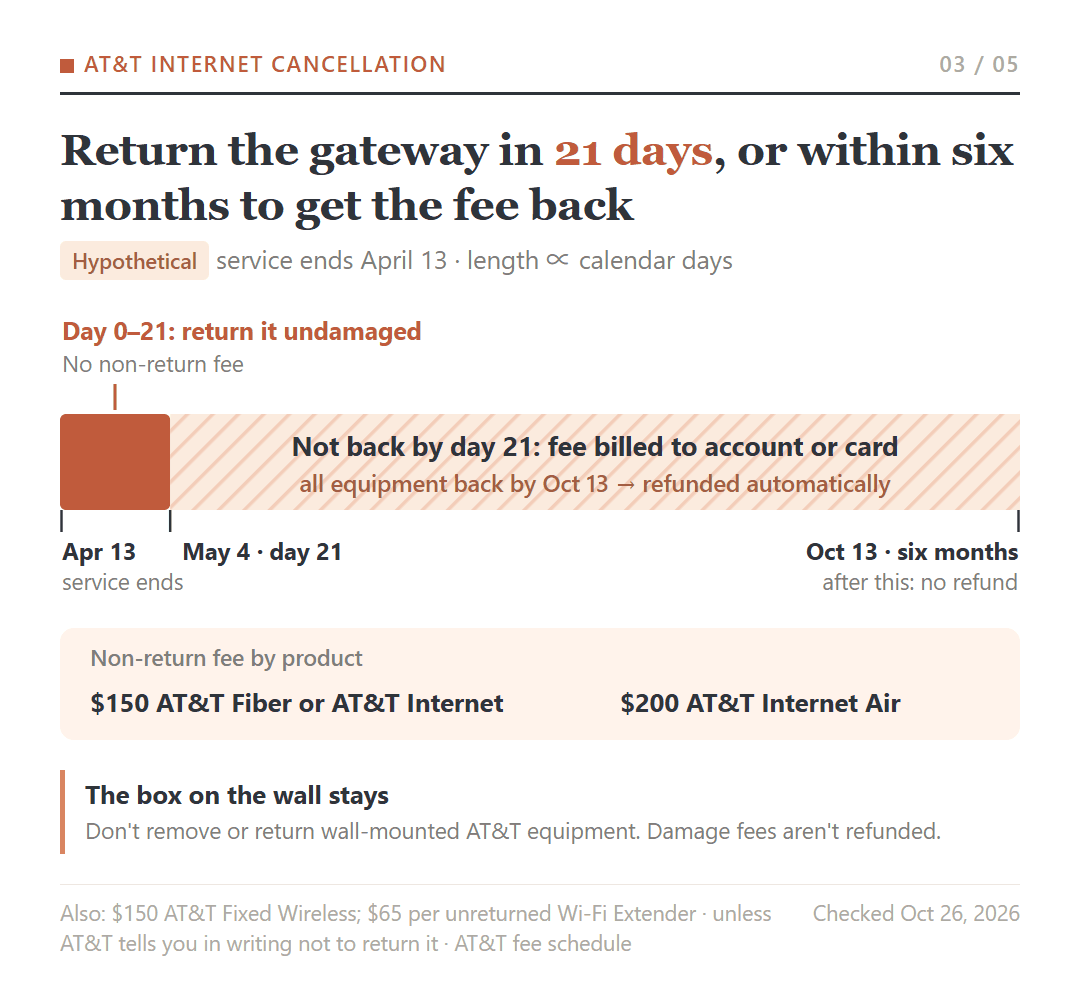
Unless AT&T tells you in writing not to, its equipment has to come back undamaged within 21 calendar days after service ends. Miss that, and AT&T’s fee schedule bills a non-return fee to your account or the card on file: $150 for an AT&T Fiber or AT&T Internet gateway, $200 for AT&T Internet Air, $150 for AT&T Fixed Wireless, plus $65 per device for an unreturned AT&T Wi-Fi Extender.
That fee isn’t necessarily final. If all the equipment is returned within six months of termination, AT&T refunds the fee automatically. Damage fees aren’t refunded, and nothing is refunded for equipment returned after six months.
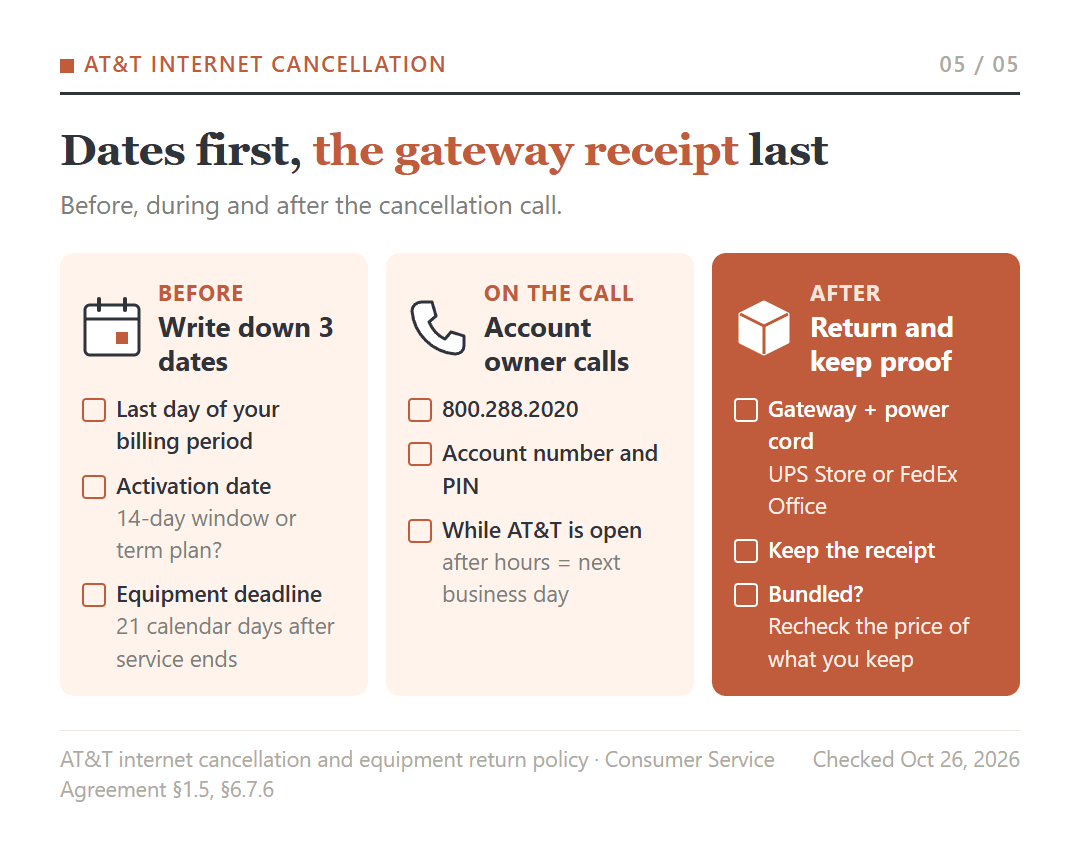
Take the gateway and its power cord to a UPS Store or FedEx Office with your AT&T account number, and keep the receipt in case the fee posts anyway. Don’t remove or return wall-mounted AT&T equipment.
For the hypothetical household whose service ends April 13, day 21 is May 4. If the non-return fee lands anyway ($150 on a Fiber or Internet plan, $200 on Internet Air), getting everything back by October 13 still brings it back.
Does an Early Termination Fee Apply to You?
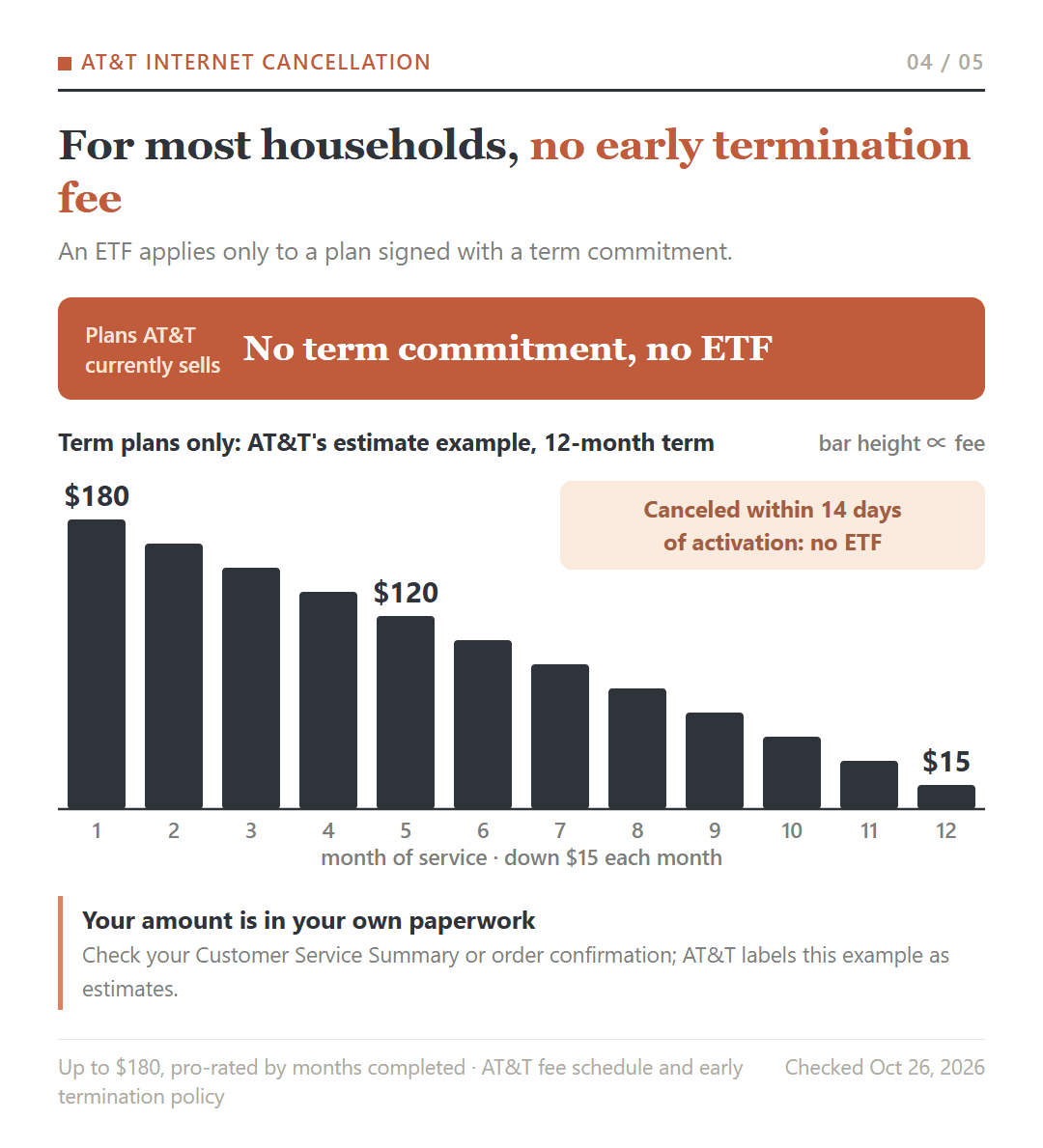
For most households, no. AT&T’s fee schedule says the home internet plans it currently sells have no term commitment and no early termination fee. An ETF applies only if you agreed to a plan with a term commitment, and then it’s up to $180, pro-rated by the months you’ve completed. Even on a term plan, canceling within 14 days of activation carries no ETF.
If you do have a term plan, the amount is whatever your Customer Service Summary or order confirmation says. AT&T’s policy page illustrates how it shrinks with an example it labels as estimates: a $180 fee on a 12-month term, prorated down $15 for each month of service, from $180 in month 1 to $15 in month 12. In that example, canceling in month 5 would cost $120.
If an ETF applies, it shows up on your bill as “Early Termination Fee” within 3 bill periods, so it may not be on the first bill you see after canceling. Whether you signed up with a term commitment is on your own Customer Service Summary or order confirmation; check it before you call.
Write Down Three Dates Before You Call AT&T
Before dialing, get three dates on paper: the last day of your current billing period, your activation date (to see whether the 14-day window or a term plan applies), and the day 21 calendar days after service will end, which is your equipment deadline.
Then the account owner calls 800.288.2020 with the account number and PIN. Call while AT&T is open: its policy says cancellation requests received when it’s closed are handled on the next regular business day, so a late-night call on the last day of your period can slip into the next one.
“I’m calling to cancel my AT&T Internet service. My current billing period ends on [date]. Can the service end on that date? Am I on a term commitment, and would any early termination fee apply? Which equipment do I need to return, and by what date?”
If a rep offers to prorate the last bill, ask how that credit will appear on the statement. Threads on AT&T’s community forum and a consumer-advocacy column describe promised prorated credits that never posted, and the agreement itself says the full month is owed.
If you bundle AT&T services, dropping internet can end the bundle discount and change the price of what you keep. AT&T wireless lines, DIRECTV, Business Internet and moving service to a new AT&T address follow their own terms.
Switching providers rather than just leaving? For a comparison, see how Spectrum’s final bill works when you cancel mid-month, or, if the new place will run on 5G, T-Mobile Home Internet’s cancellation and gateway return.
AT&T and four other internet providers are laid out together in our guide to the final bill and equipment return when you cancel internet service.
Put the period end date on the calendar first and the return deadline right after it. A household that hits both dates keeps the next month’s charge and the non-return fee in its own bank account.
Sources: AT&T, Consumer Service Agreement (sections 1.5, 6.4.1, 6.4.2 and 6.7.6); AT&T, Internet cancellation policy; AT&T, Internet Fee Schedule (Consumer); AT&T, Return your old gateway. Checked Oct. 25, 2026. The household in the examples is hypothetical, its $80 monthly charge is a round number rather than an AT&T price, and the figures leave out taxes and fees.