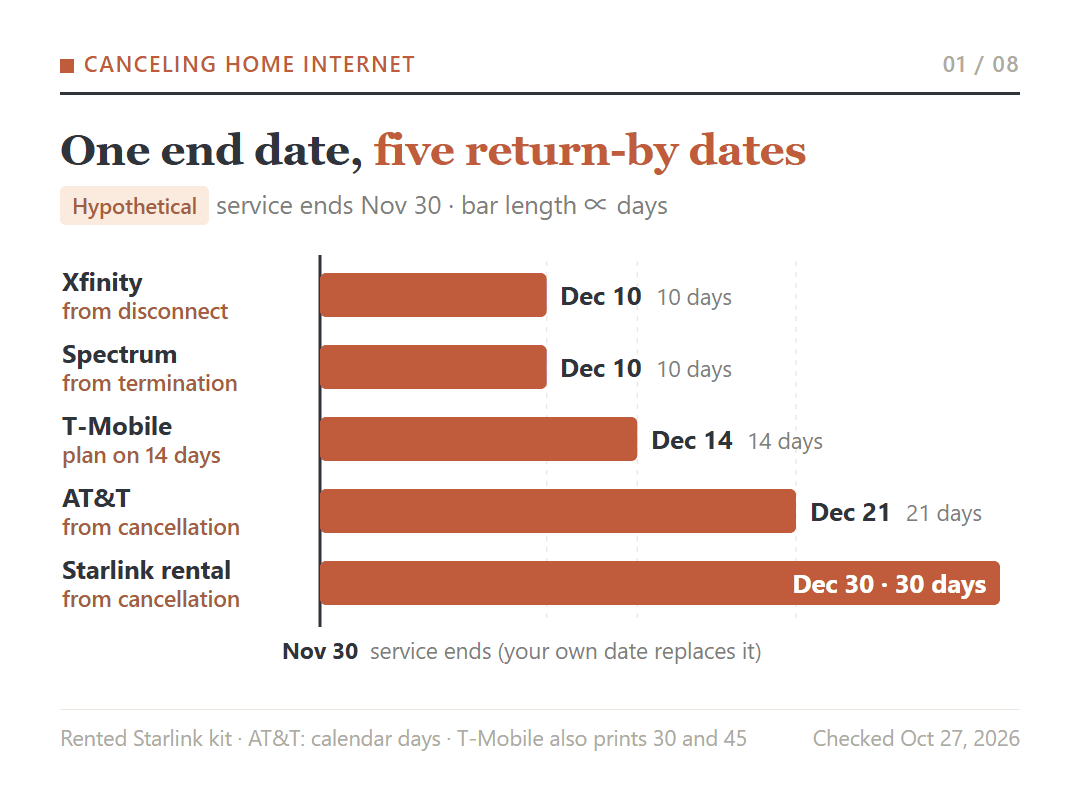
Ten, 10, 21, 14 and 30. Those are the equipment-return windows that Xfinity, Spectrum, AT&T, T-Mobile Home Internet and Starlink (for a rented kit) put in their own terms, and the clocks don’t even start from the same event. Xfinity counts from the day service is disconnected, Spectrum from termination, AT&T and Starlink from cancellation, and T-Mobile prints 14, 30 and 45 days on three different pages of its own site.
The last month splits too. Spectrum, AT&T, T-Mobile and Starlink don’t give back unused days once a billing period has started, unless state law requires it (Maine does, as noted below). Xfinity’s agreement says only that it “may refund” prepaid monthly fees charged after termination.
So canceling home internet comes down to three decisions: which date to end service on, whether an early termination fee applies, and what goes back by when. Current internet plans from Xfinity, Spectrum and AT&T carry no early termination fee, and T-Mobile’s carry no annual contract; the exceptions are older term agreements and Starlink kits that came with a service commitment. The two numbers that decide the rest are on your own account: the end date of your current service period, and the return-by date for the equipment you actually have.
To see how far apart the return dates land, take a hypothetical household whose service ends Nov 30 (your own date replaces it). The return-by dates come out to Dec 10 for Xfinity and Spectrum, Dec 14 for T-Mobile if you plan on its 14-day figure, Dec 21 for AT&T and Dec 30 for a rented Starlink kit.
How the Final Bill Works at Each Provider
Here is the last-month rule and the early termination fee side by side, as each provider’s own terms state them.
| Provider | Last month | Early termination fee |
|---|---|---|
| Xfinity | Agreement says it “may refund” prepaid fees charged after termination | None on current internet offers; a minimum term agreement may carry one |
| Spectrum | Full monthly charge, no proration | $0.00 on the internet label |
| AT&T | No proration unless the law requires it; billed in advance | None on plans sold now; older term plans up to $180, reduced by months completed |
| T-Mobile Home Internet | Cancellation typically takes effect at the end of the current cycle; you pay through it | No annual contracts |
| Starlink | No partial-month refund; cancel before the next invoice is generated | A kit that came with a service commitment carries a Change Fee if you leave early; the amount is on your order |
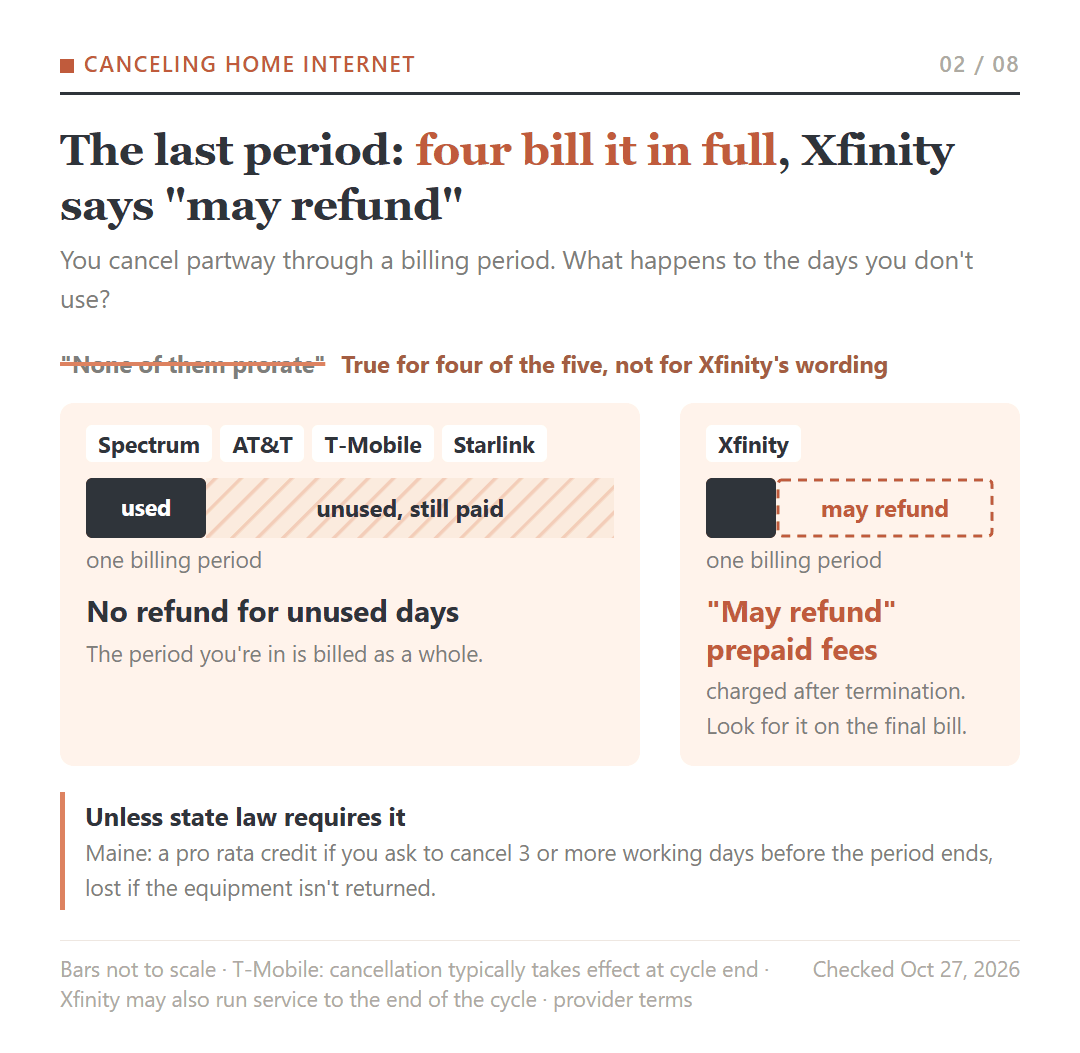
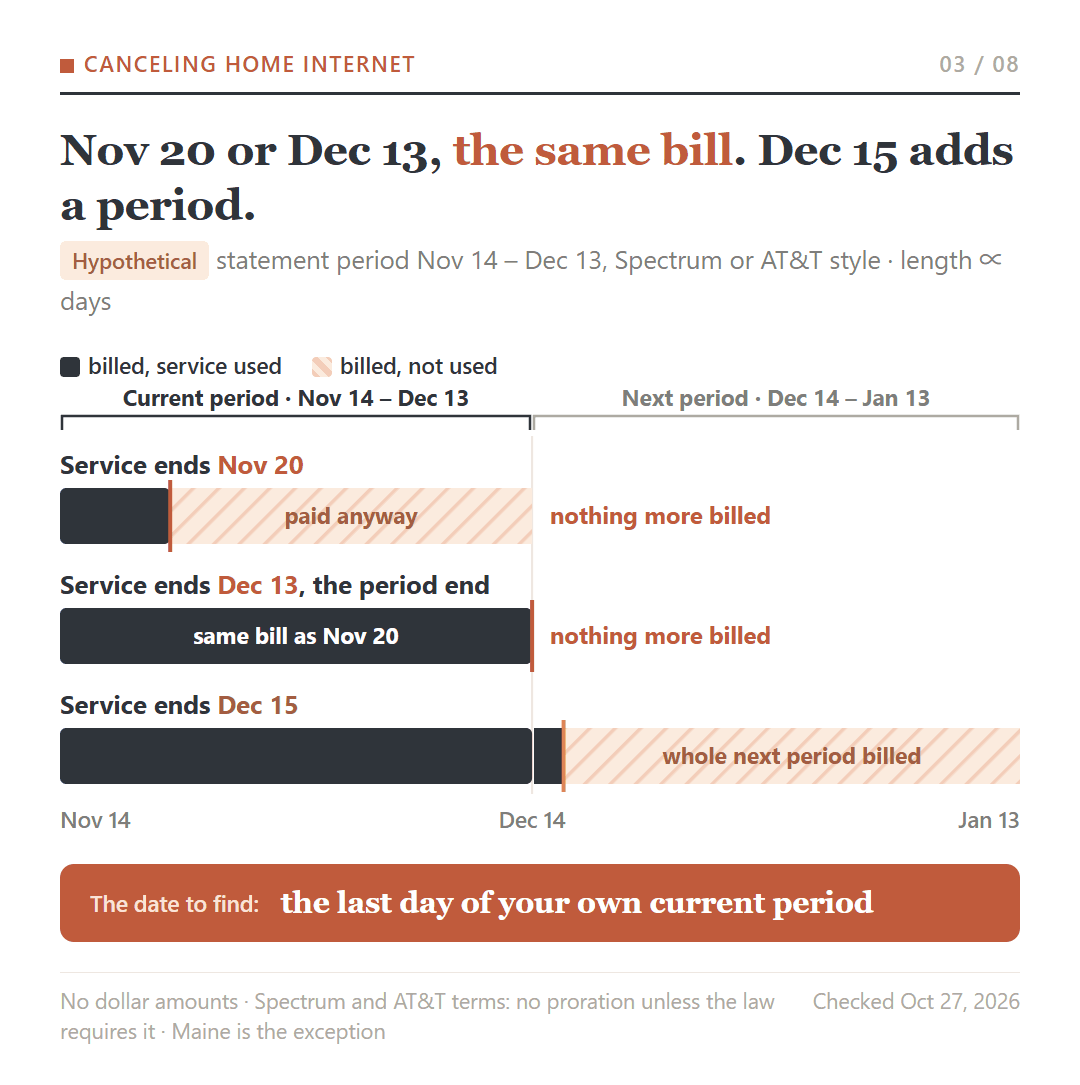
That makes the end of your current service period the date to find before you call. For Spectrum, AT&T, T-Mobile and Starlink, ending service at that date, not after it, costs nothing extra; once the next period starts, it’s billed in full. For Starlink, that means canceling at least a day before your billing date. For Xfinity the date matters less, because the final bill depends on how its “may refund” language is applied to your account.
Here’s a hypothetical statement period of Nov 14 to Dec 13 on a Spectrum or AT&T account. Ending service Dec 13 costs the same as ending it Nov 20, since the period is already billed in full. Ending it Dec 15 adds the whole Dec 14 to Jan 13 period.
One state reverses the default. In Maine, a provider must give a pro rata credit for the days after cancellation if you ask to cancel 3 or more working days before the end of the monthly billing period, and cable service follows the same 3-working-day rule. You lose the broadband credit if you don’t return the provider’s equipment.
Five Return Windows, and What Each Costs If You Miss It
I read the five providers’ terms side by side, and the return clause is where they differ most: the number of days changes, and so does the event that starts the count. That’s why there’s no single deadline to plan around, only the one that applies to your provider and your equipment.
| Provider | Return within | If it doesn’t come back |
|---|---|---|
| Xfinity | 10 days from the date service is disconnected | Unreturned Equipment Fee; amount not published |
| Spectrum | 10 days from termination | Per unit: modem $90, wireless router $90, WiFi Extender $60 |
| AT&T | 21 calendar days from cancellation | $150 Fiber or Internet, $200 Internet Air, $150 Fixed Wireless, plus $65 per Wi-Fi Extender; refunded if returned within 6 months |
| T-Mobile Home Internet | 14 days on its cancel page (30 and 45 on others); plan on 14 | Up to $370 plus tax |
| Starlink (rented kit) | 30 days from cancellation | The kit’s full price, as shown on your order |
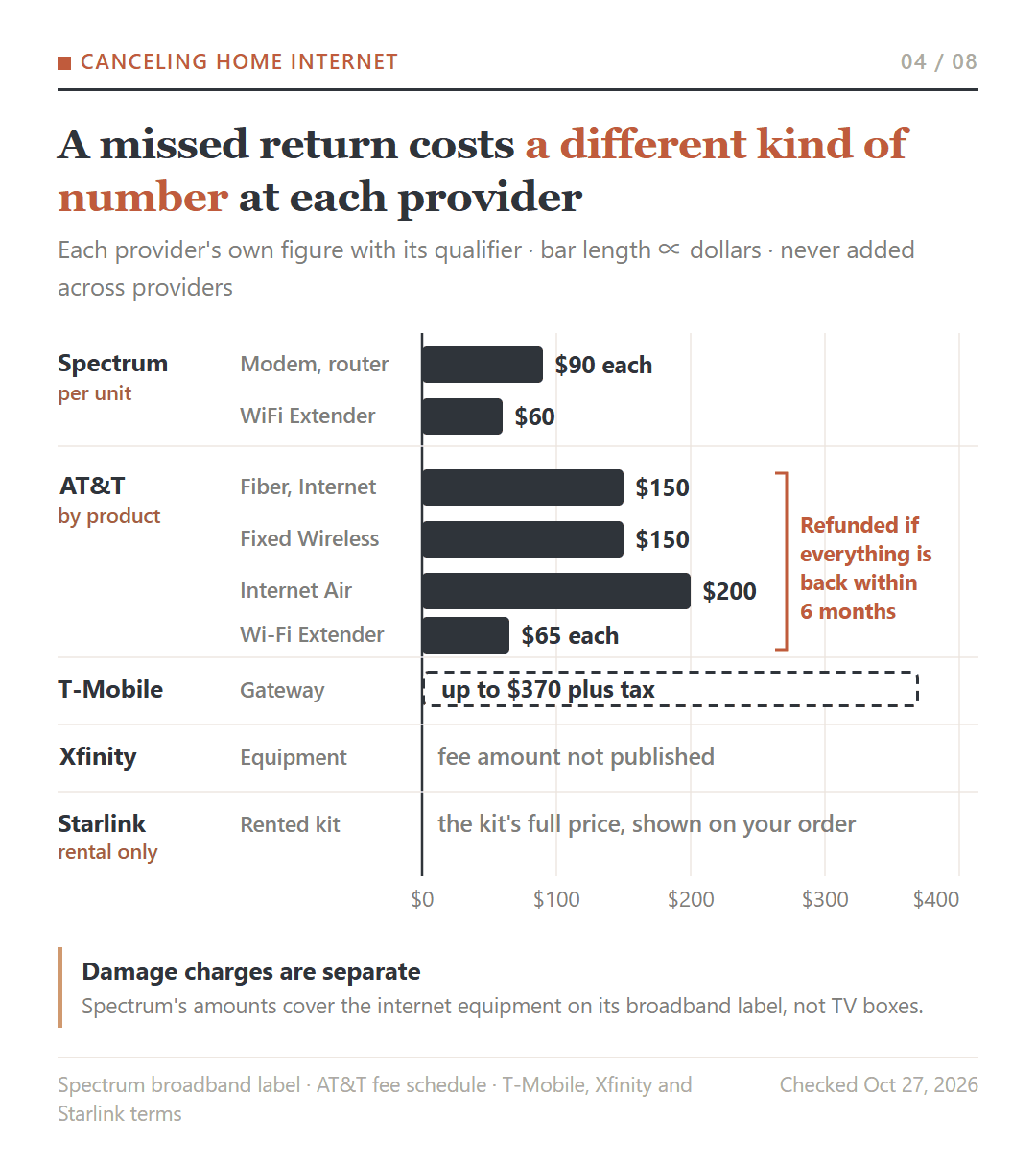
These charges don’t add up into one figure across providers, and they aren’t the whole picture for every account: damage charges are separate, and Spectrum’s amounts cover the internet equipment on its broadband label, not TV boxes. The provider sections below give the detail that changes the answer for each one.
Xfinity: “May Refund” Is Not the Same as “Will Refund”
Xfinity’s Residential Services Agreement has you pay up to the date the agreement is terminated and the services are disconnected (subject to applicable law), and says Xfinity “may refund all prepaid monthly service fees charged for the Services after the effective date of termination.” The same section also reserves Xfinity’s right to continue all services through the end of the billing cycle in which it received your notice. So don’t assume a credit either way; look for it on the final bill.
Equipment goes back within 10 days of the date service is disconnected, and the agreement says fees may accrue until service is disconnected and all Xfinity equipment has been returned. The Unreturned Equipment Fee is billed per Xfinity’s schedule; the agreement doesn’t print the amount. Current internet offers carry no annual contract or early termination fee, but if you signed a minimum term agreement, review it for one.
For the return receipt to keep and what changes if you also have Xfinity Mobile, see our guide to canceling Xfinity, its early termination fee and the equipment return.
Spectrum: Cancel on or Before the Last Day of Your Period
Spectrum’s residential terms charge the full monthly amount “without pro-ration,” even if you terminate before the service period ends, unless your state’s law requires otherwise. They also say that unless you cancel on or before the last day of the current monthly service period, you’re charged in full for the next one. That last day is the date to put on your calendar.
Modems, routers and extenders go back within 10 days of termination. If they don’t, the broadband label lists $90 per modem, $90 per wireless router and $60 per Spectrum WiFi Extender. A hypothetical household that keeps one modem and one wireless router would see $90 + $90 = $180 in label charges. The internet label shows an early termination fee of $0.00.
The return receipt and what happens to a bundled Spectrum Mobile line are in our explainer on Spectrum’s final bill and why it isn’t prorated.
AT&T: The Non-Return Fee Comes Back If the Gateway Does
AT&T’s Consumer Service Agreement says that, unless required by applicable law, there is no proration and you owe the full month even if service ends before the billing cycle does. Because AT&T bills each cycle in advance, the period you’re in when you cancel is already paid for.
Return the equipment within 21 calendar days of cancellation, unless AT&T tells you in writing not to, at a UPS Store or FedEx Office with your account number. Don’t remove wall-mounted AT&T equipment. Miss the window and the fee is $150 for AT&T Fiber or AT&T Internet, $200 for AT&T Internet Air or $150 for AT&T Fixed Wireless, plus $65 for each Wi-Fi Extender. If everything comes back within six months of termination, the non-return fee is refunded automatically; damage fees are not.
In the hypothetical Nov 30 example, that’s a Dec 21 return date and a May 30 refund cutoff. An AT&T Fiber household that kept the gateway and one extender would be charged $150 + $65 = $215, and would get it back by returning both by May 30.
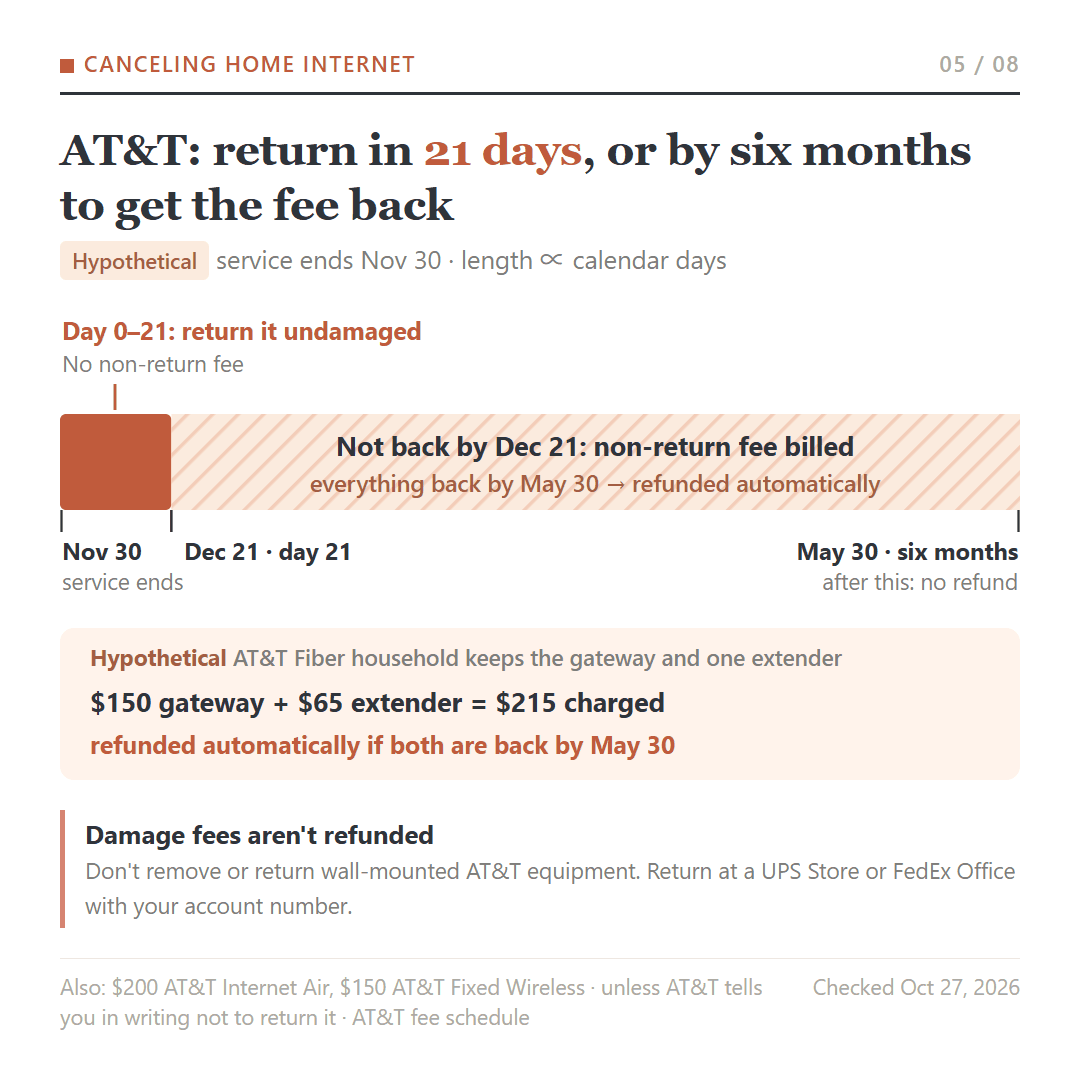
AT&T home internet plans currently sold don’t carry a term commitment or an ETF; older term plans can owe up to $180, reduced for the months completed. The cancel call and the term-plan math are in our AT&T Internet cancellation guide.
T-Mobile Home Internet: Three Pages, Three Deadlines, Plan on 14 Days
T-Mobile says cancellations are future dated and typically take effect at the end of your current billing cycle, and you’re responsible for charges through the end of that cycle. Its plans page lists no annual contracts.
The return deadline is where T-Mobile’s own pages disagree. The cancel-service page says the gateway and mesh Wi-Fi extender must be returned within 14 days, using a return label emailed automatically after cancellation. The device-returns page says 30 days of starting the return, and the Home Internet billing and 15-Day Test Drive pages say 45 days. Plan on 14, and ask T-Mobile for your exact return-by date.
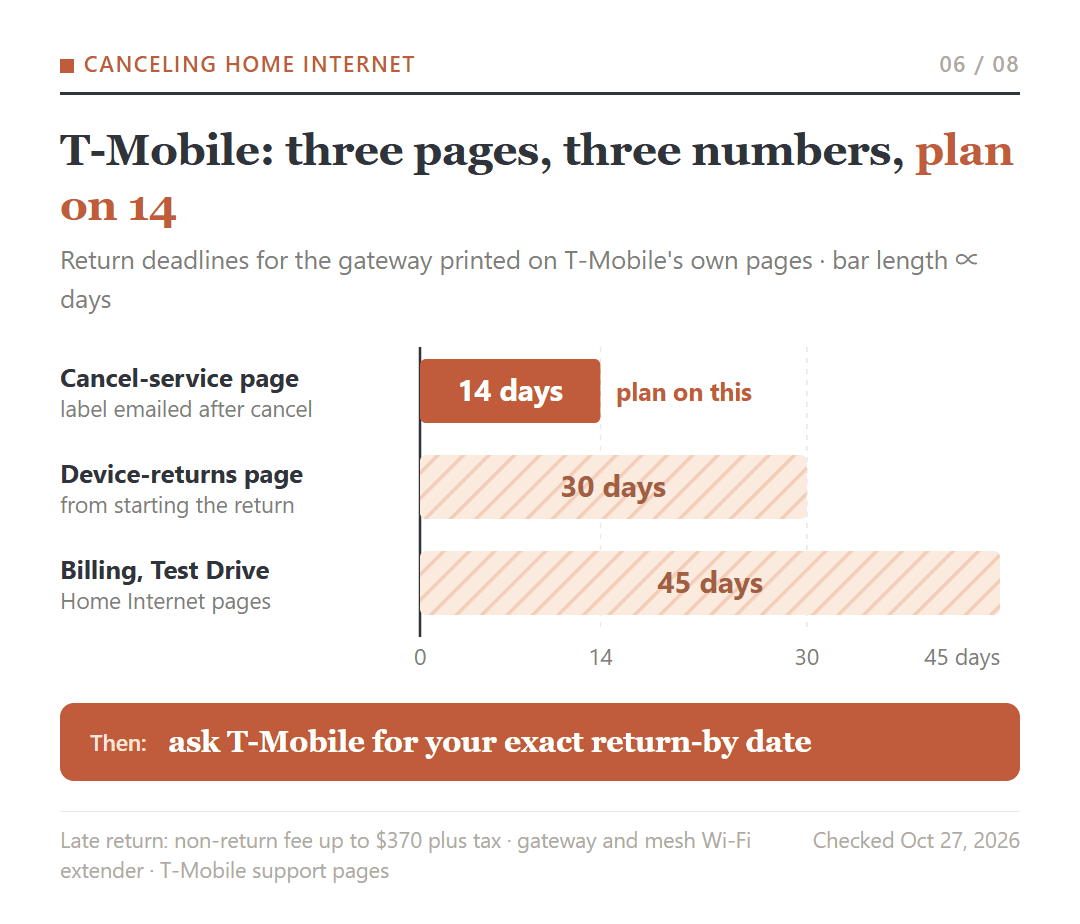
A late return can bring a non-return fee of up to $370 plus tax. Damage is listed differently on two pages: a one-time $79 charge for excessive damage on the billing page, and up to $370 on the returns page. The return label and what happens to other T-Mobile lines are in our guide to canceling T-Mobile Home Internet and returning the gateway.
Starlink: How You Got the Kit Decides What You Owe
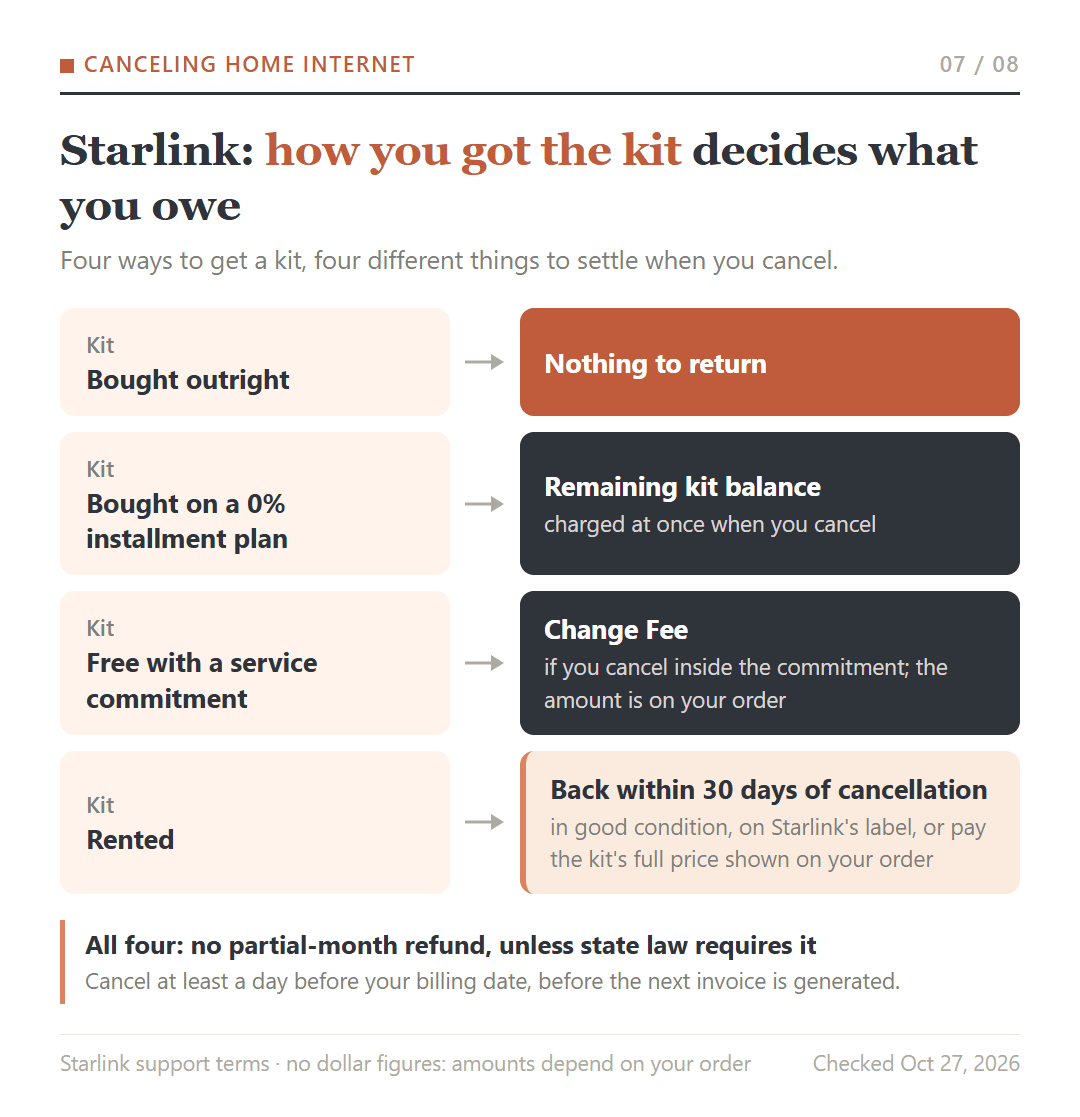
Starlink doesn’t refund a partial month; it tells customers to cancel before the invoice statement is generated, so cancel at least a day before your billing date. What else you owe depends on how the kit came to you.
- Bought outright: nothing to return.
- Bought on a 0% installment plan: canceling charges the remaining kit balance at once.
- Free kit with a service commitment: canceling inside the commitment brings a Change Fee; the amount is on your order.
- Rented: return it in good condition within 30 days of cancellation, using the label Starlink issues when you cancel, or pay the kit’s full price shown on the order page.
The Change Fee amounts and the 30-day trial refund are covered in our breakdown of what you owe when you cancel Starlink.
The Two Weeks Around Your Cancel Date
- Find the end date of your current service period on your latest bill (for Starlink, your billing date).
- List the equipment you actually have: gateway, modem, router, extenders, power adapter, satellite kit. Note whether you ever signed a term agreement or got a Starlink kit on installment or commitment.
- Cancel so service ends at that period end, not after it.
- Return everything before the return-by date that applies, and keep proof: a store receipt listing the equipment and date, or the tracking number on the prepaid label.
- Read the final statement against both dates.
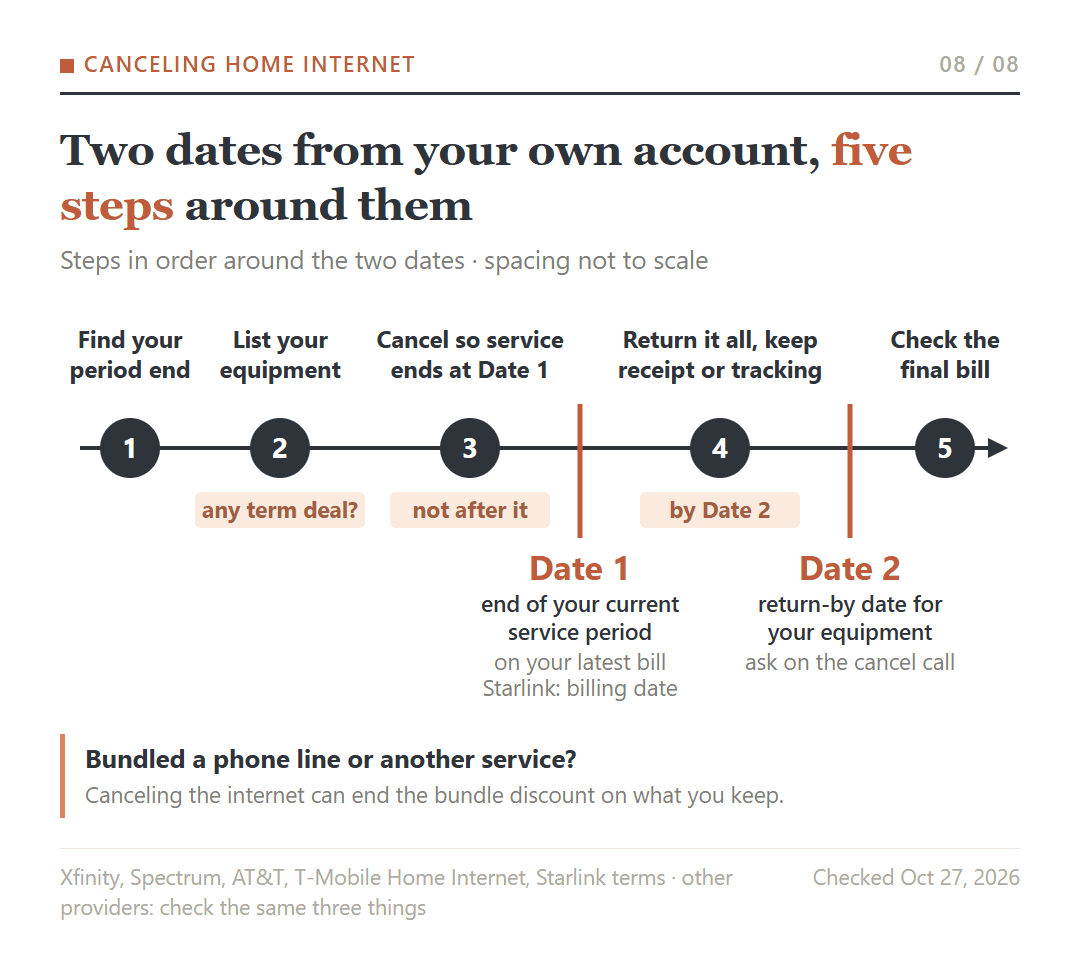
One question covers both dates on the cancel call:
Before I confirm: what date will my service end, what is the last billing period I’ll be charged for, and what is the return-by date for each piece of equipment on my account?
If a phone line or another service is bundled with your internet, canceling the internet can end the bundle discount on what you keep. Verizon Fios, Cox, Frontier, Optimum and other providers aren’t covered here; check the same three things in your provider’s terms: the final-month rule, the return window and what starts it, and the non-return charge.
Of the two dates, the return-by date is the one that can still cost you after you’ve moved on. The return receipt matters more than the cancel call.
Sources: Xfinity Residential Services Agreement and Xfinity Internet FAQ; Spectrum Residential General Terms and Spectrum broadband disclosure; AT&T Consumer Service Agreement, AT&T Internet fee schedule and AT&T internet cancellation policy; T-Mobile cancel service, Home Internet billing, device returns and 15-Day Test Drive pages; Starlink support; Maine 10 M.R.S. §1500-U and 30-A M.R.S. §3010. Checked October 27, 2026. All dates and equipment in the examples are hypothetical; your own statement dates replace them.