
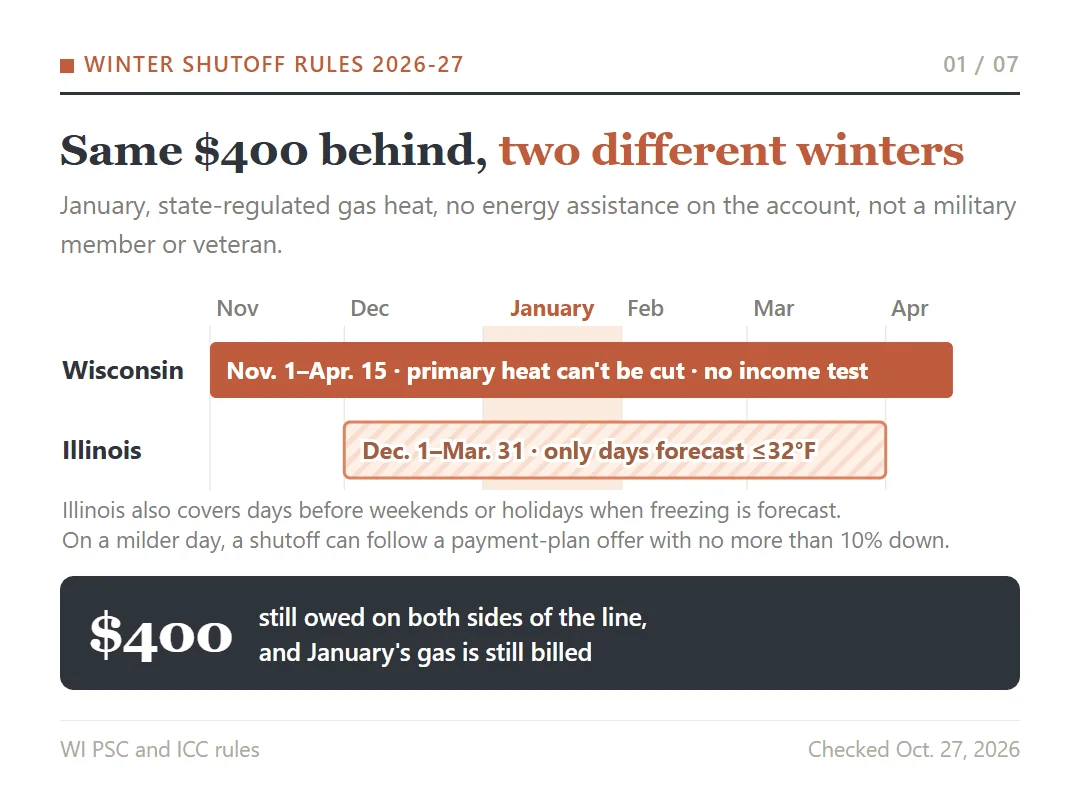
Picture two households in January, one on each side of the Wisconsin–Illinois line. Both heat with natural gas from a state-regulated utility, both are $400 behind, neither has energy assistance on the account, and neither is a military member or veteran.
On the Wisconsin side, the utility can’t disconnect the service that is the home’s primary heat source for nonpayment between Nov. 1 and Apr. 15, and there’s no income test. On the Illinois side, the same $400 is protected only on days when the forecast is at or below 32°F, plus days before a weekend or holiday when freezing is forecast.
On a milder January day in Illinois, a shutoff can still happen, although the utility first has to offer a payment plan with no more than 10% down. In both houses, the $400 is still owed and January’s gas is still billed.
That gap is the real answer to “can they shut off my heat in winter?” No federal law stops winter utility shutoffs. Protection comes from your state, and it generally covers utilities regulated by the state commission; municipal utilities, rural electric co-ops and propane or oil dealers usually aren’t covered, though some follow the rules voluntarily.
In most of the 11 cold-weather states below, protection also isn’t automatic. You have to qualify, tell or enroll with the utility, or keep a payment plan. And everywhere, winter protection pauses a shutoff; it doesn’t pause the bill, so a past-due balance left when your state’s window closes can lead to a shutoff.
Three checks settle your own case: whether your utility is covered, what your state’s window asks of you, and where the money to catch up comes from. Readers in Minnesota, Ohio, Pennsylvania and Massachusetts will find a detailed post linked in their state’s section.
Does Your State’s Winter Rule Reach Your Utility at All?
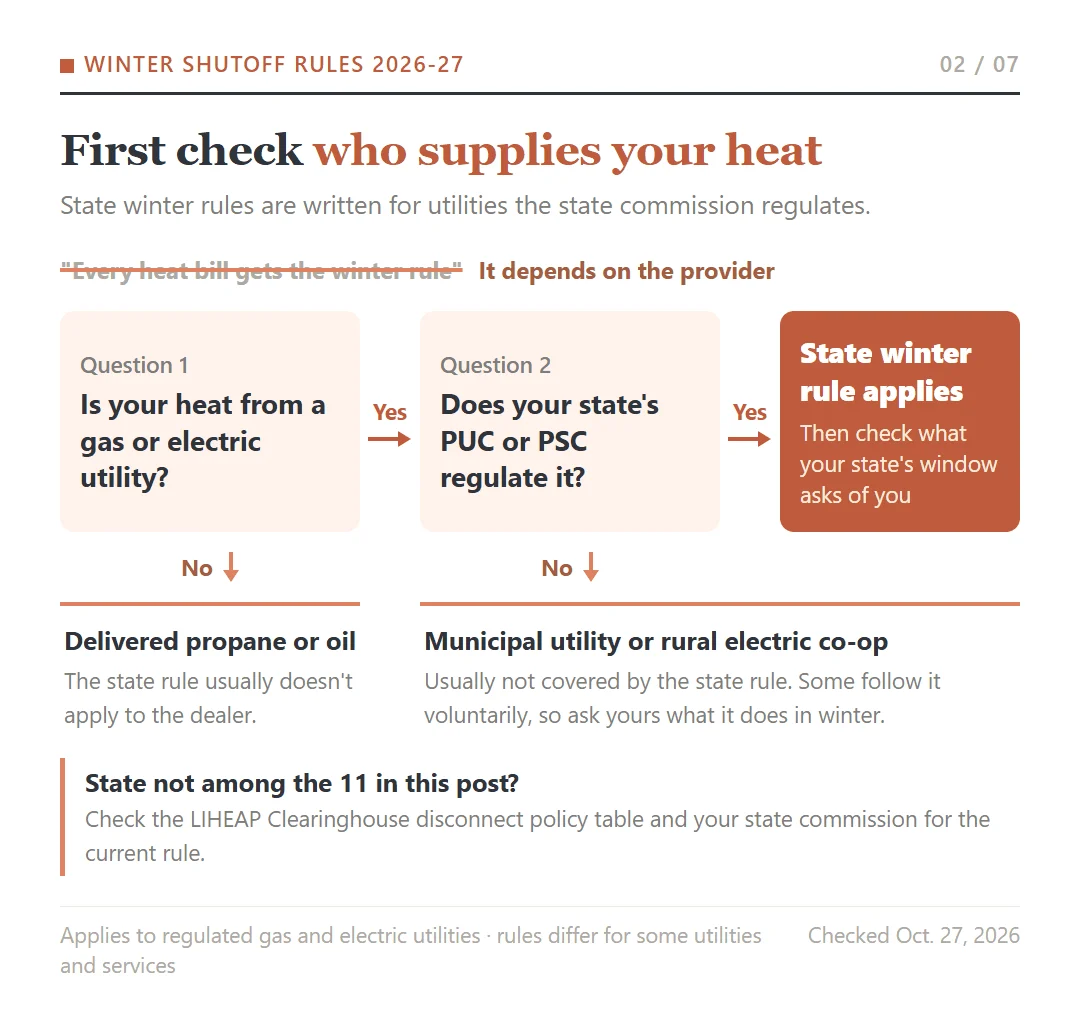
Start with the company name on your bill. State winter rules are written for the gas and electric utilities that your state’s utility commission, usually called the PUC or PSC, regulates.
If your electricity comes from a municipal utility or a rural electric co-op, or you heat with delivered propane or oil, the state rule usually doesn’t apply to that provider. Some of them follow it voluntarily, so ask yours what it does in winter before you count on it. Massachusetts is the exception this winter: its rule reaches municipal light plants too.
This post covers 11 states with 2026-27 dates from their regulators. If yours isn’t among them, many other states have date- or temperature-based rules too; the LIHEAP Clearinghouse’s disconnect policy table lists them by state, and your state commission has the current version.
Your State’s 2026-27 Window, and the Catch in Each
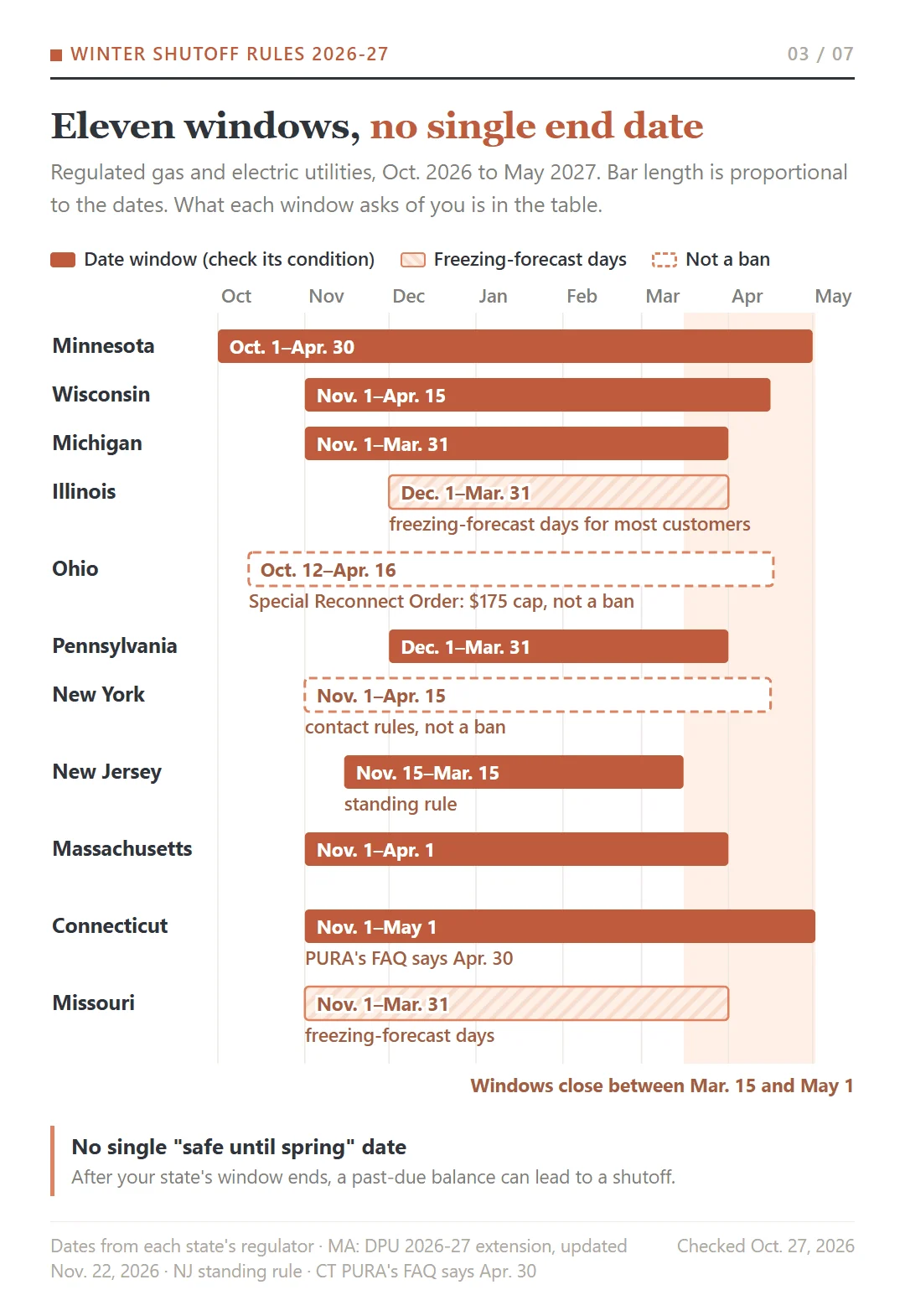
The dates below are for regulated gas and electric utilities. The third column matters more than the dates: it’s what has to be true, or what you have to do, for the window to protect you.
| State | 2026-27 window | What it takes |
|---|---|---|
| Minnesota | Oct. 1–Apr. 30 | Protected only while you set up and keep a payment plan with the utility |
| Wisconsin | Nov. 1–Apr. 15 | No income test for primary heat service; reconnection waits for payment arrangements |
| Michigan | Nov. 1–Mar. 31 | Seniors 65+ or income-qualified; enroll through your utility |
| Illinois | Dec. 1–Mar. 31 | Whole season with LIHEAP or PIPP on the account, electric space heat, or military or veteran status; otherwise freezing-forecast days only |
| Ohio | Oct. 12, 2026–Apr. 16, 2027 (Special Reconnect Order) | No ban: pay up to $175 once per utility, then a payment plan |
| Pennsylvania | Dec. 1–Mar. 31 | Household income at or below 250% of the federal poverty level |
| New York | Nov. 1–Apr. 15 (cold weather period) | Not a ban: extra contact and health-and-safety referral duties for the utility |
| New Jersey | Nov. 15–Mar. 15 (standing rule) | A listed benefit or hardship; contact the utility and re-enroll each winter |
| Massachusetts | Nov. 1, 2026–Apr. 1, 2027 (DPU extension; standing rule Nov. 15–Mar. 15) | Financial hardship, heating service; municipal light plants included this winter |
| Connecticut | Nov. 1–May 1 (PURA’s FAQ says Apr. 30) | Hardship-coded or medically protected; renew the documentation each year |
| Missouri | Nov. 1–Mar. 31 | Protected only on days when below-freezing temperatures are forecast |
The windows close anywhere from Mar. 15 to May 1, so there’s no single “safe until spring” date. Find your own state’s end date, because after it a remaining past-due balance can lead to a shutoff.
Wisconsin is the only state on the list with a full-window ban that a residential household doesn’t have to qualify for. Even there, the utility doesn’t have to reconnect a home that’s already been shut off until payment arrangements are made, so a household without service before Nov. 1 needs to call the utility rather than wait for the window.
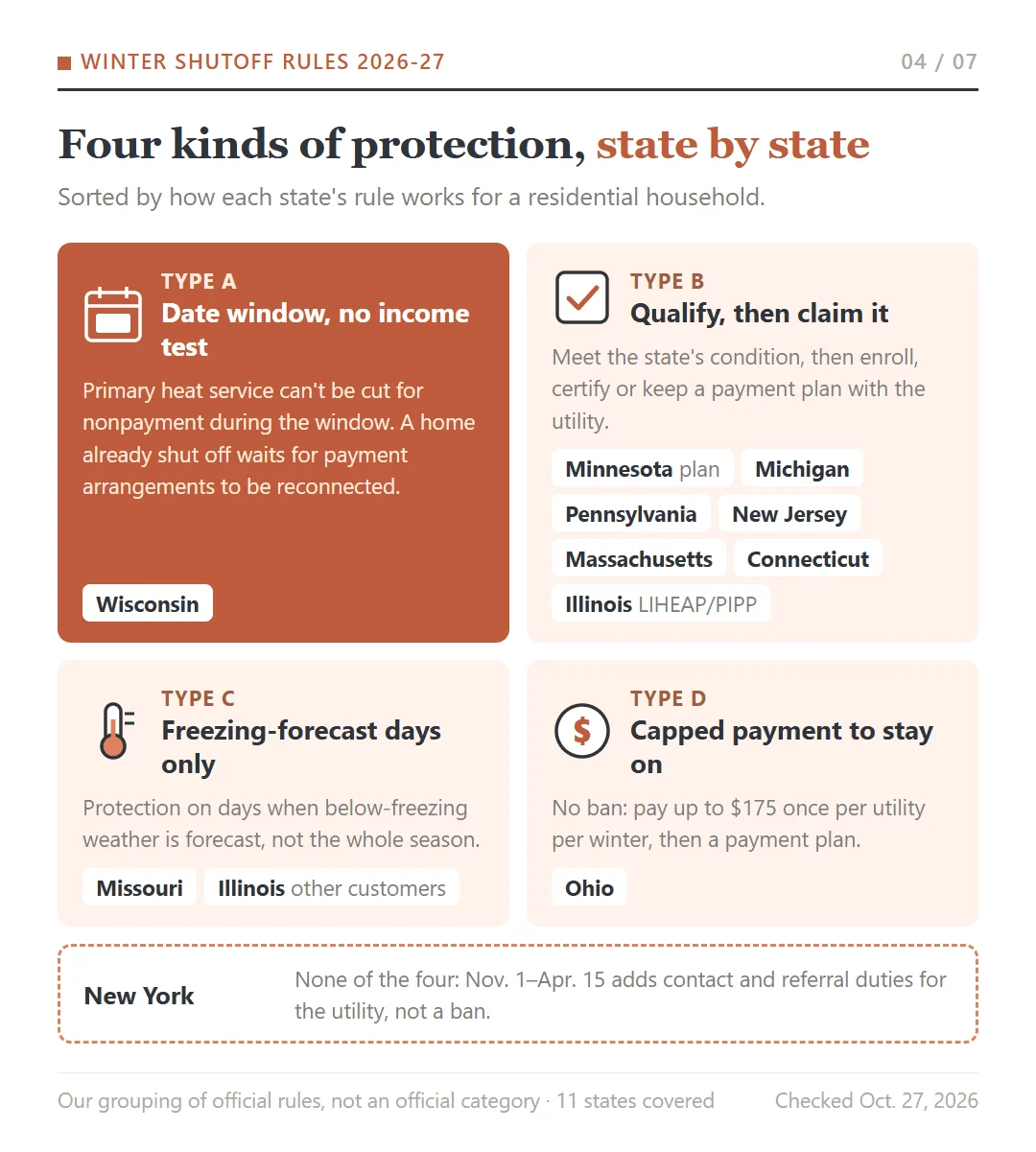
Sorted by how they work, the rules fall into four kinds: a date window with no income test (Wisconsin), a window you must qualify for and claim (most of the list), protection only on freezing-forecast days (Missouri, and Illinois for most customers), and a capped payment to stay connected (Ohio). New York adds duties for the utility instead of a ban. The four-way sort is a reading aid built from the official rules, not a category regulators use.
Where Protection Has to Be Claimed
In seven of these states, the window protects you only after you meet the state’s condition and the utility knows it. The condition moves from state to state: Pennsylvania uses 250% of the federal poverty level, Michigan 150% or certain benefits, Connecticut 60% of state median income or assistance, and New Jersey a list of benefits or a hardship you can self-certify. Pennsylvania households above their line can still face a winter shutoff after notice, and Illinois’s LIHEAP condition is in the next section.
The action differs too. Michigan’s Winter Protection Plan, for seniors 65 and older and income-qualified customers (including those on SNAP, Medicaid, MDHHS cash assistance or SSI), is something you enroll in through your utility. Low-income enrollees pay 7% of the estimated annual bill each month, any arrears are spread out before the next heating season, and they must show they applied for heating assistance.
In New Jersey’s Winter Termination Program, you must contact the utility and re-enroll every winter. In Massachusetts, a utility or municipal light plant can’t shut off your heating service while you’re in financial hardship, once you certify it with the utility. This winter the DPU stretched the standing Nov. 15–Mar. 15 window to Nov. 1, 2026 through Apr. 1, 2027; if a shutoff is scheduled anyway, the DPU Consumer Division is at (617) 737-2836. Connecticut’s protection covers hardship-coded or medically protected customers, and the documentation is renewed each year.
Minnesota’s window runs Oct. 1–Apr. 30 but protects you only while you set up and keep a payment plan. How that plan is sized and how to appeal it are in how Minnesota’s Cold Weather Rule payment plan works.
When the Rule Isn’t a Season-Long Ban
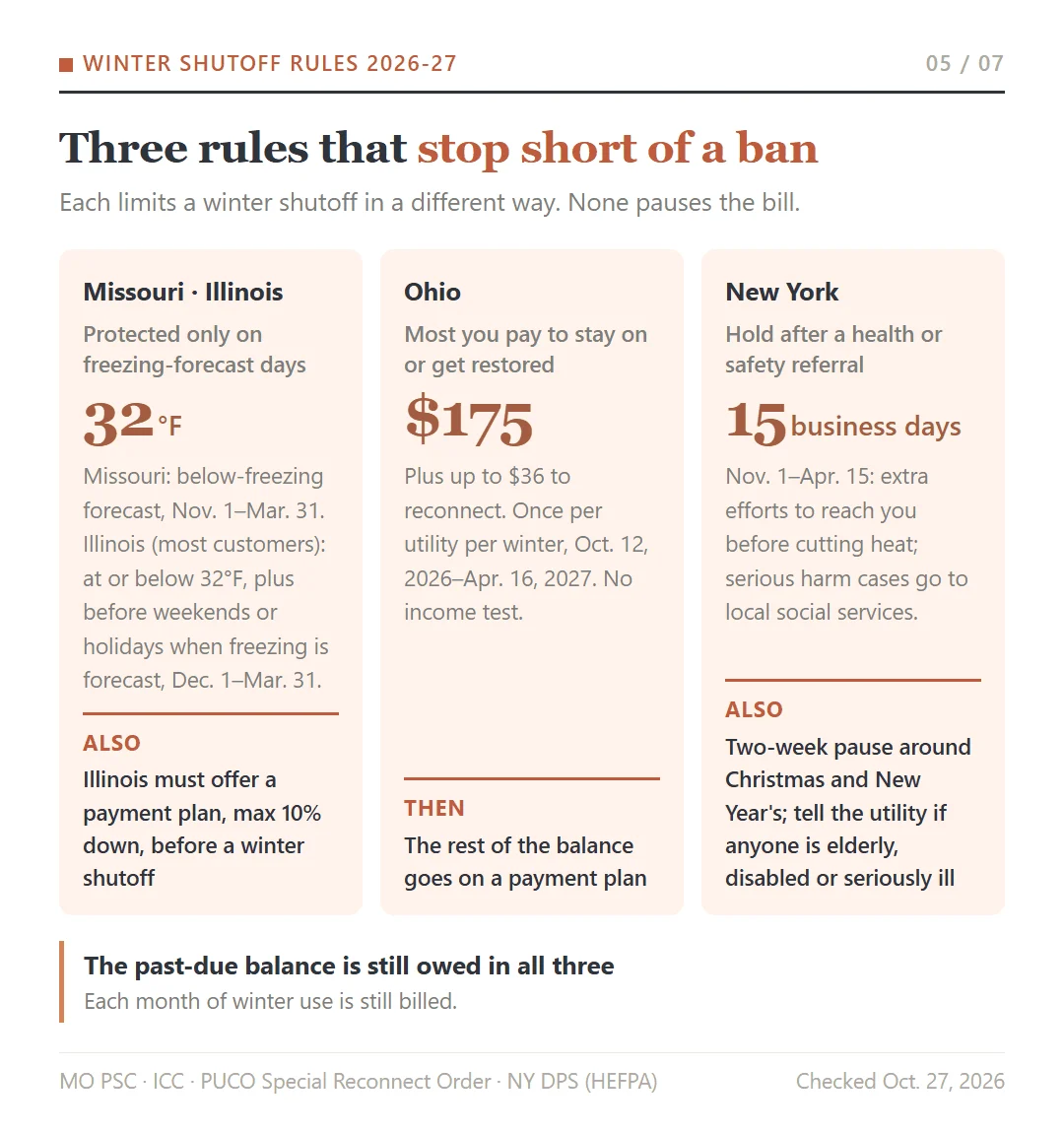
Missouri protects heat-related service from Nov. 1 to Mar. 31 only on days when below-freezing temperatures are forecast. Registered elderly or disabled customers under 150% of the poverty level get more protection if they pay at least half the bill, and municipal systems, co-ops and delivered propane aren’t covered.
Illinois works the same way for other heating customers: protection on days forecast at or below 32°F and before weekends or holidays when freezing is forecast, plus a payment plan offer with no more than 10% down before any winter shutoff. Households with LIHEAP or PIPP on the account, electric space-heating customers, and military members and veterans are protected for the whole Dec. 1–Mar. 31 season.
If I lived in Illinois and heated with gas, I would get a LIHEAP application in before December, since having that assistance on the account is what moves a household from freezing-day protection to the full season.
Ohio has no winter ban at all. Its Special Reconnect Order, Oct. 12, 2026–Apr. 16, 2027, lets any residential customer of a PUCO-regulated gas or electric utility pay no more than $175, plus up to $36 to reconnect, to stay on or get service back, once per utility per winter, then go on a payment plan for the rest, with no income test. The remaining steps are in how Ohio’s $175 Special Reconnect Order works.
New York’s Nov. 1–Apr. 15 cold weather period is not a shutoff ban. Before cutting heat-related service, the utility has to make extra efforts to reach you, and if a shutoff would seriously harm someone’s health or safety it must refer the case to local social services and hold off 15 business days. Nonpayment shutoffs also pause for two weeks around Christmas and New Year’s; if anyone in the home is elderly, disabled or seriously ill, tell the utility.
Where the Money to Catch Up Comes From
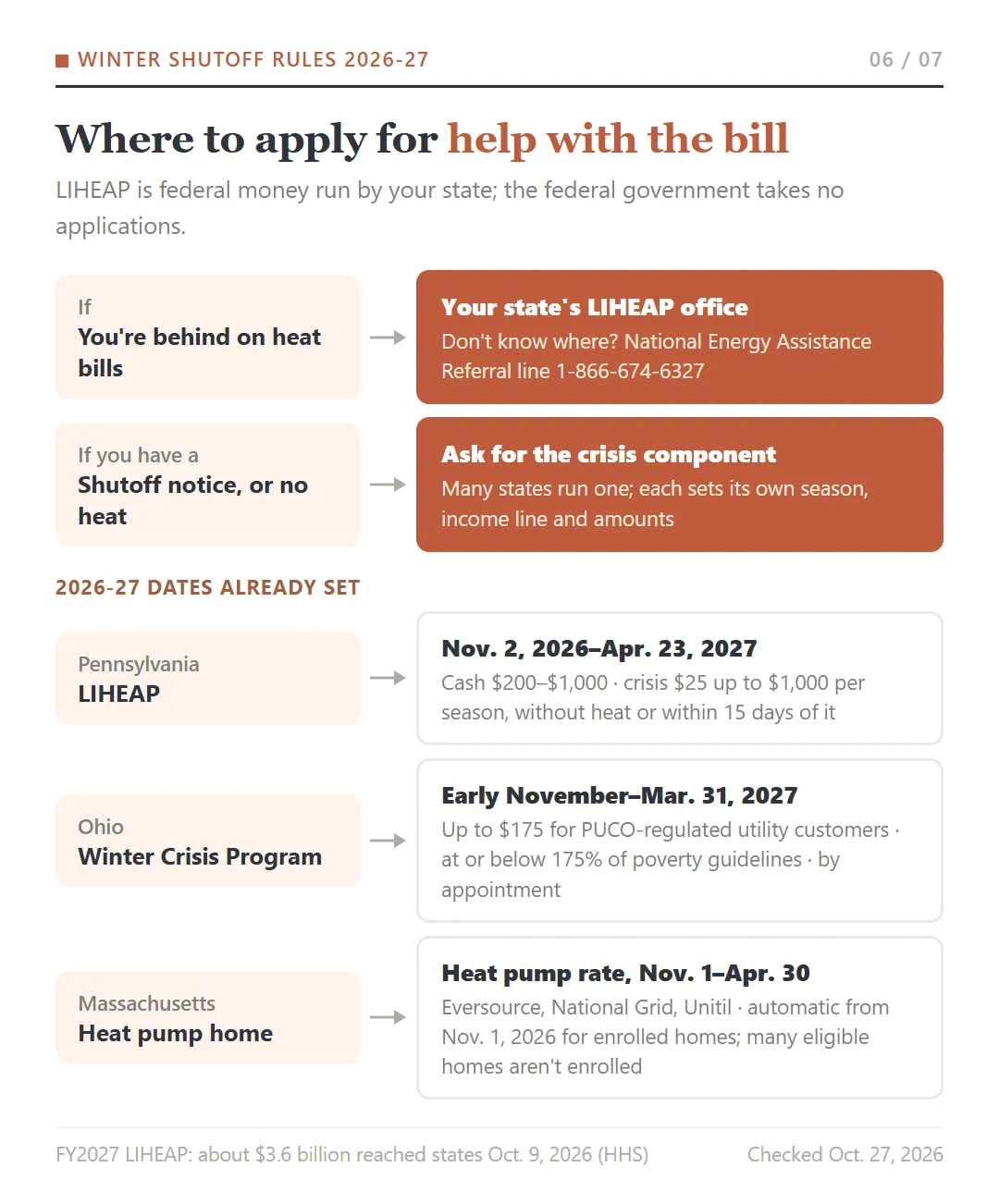
The main source is LIHEAP, federal money that your state (or tribe) runs; the federal government doesn’t take applications. According to HHS, about $3.6 billion of fiscal 2027 funding, 90% of the annual amount under the current stopgap law, went out to states on Oct. 9, 2026.
Each state sets its own season, income line and benefit amounts, and many also run a crisis component for a shutoff notice or no heat. If you don’t know where to apply, call the National Energy Assistance Referral line at 1-866-674-6327 or use the LIHEAP Clearinghouse’s state-by-state referral page.
Pennsylvania and Ohio have already set their 2026-27 assistance dates. Pennsylvania’s LIHEAP season runs Nov. 2, 2026–Apr. 23, 2027, with cash grants of $200–$1,000 and crisis grants of $25 up to $1,000 per season when you’re without heat or within 15 days of it; who qualifies and how to look up your grant are in Pennsylvania LIHEAP 2026-27: cash and crisis grants. Ohio’s Winter Crisis Program runs Nov. 2, 2026 through Mar. 31, 2027, so it’s open now, for households at or below 175% of the federal poverty guidelines, paying up to $175 for PUCO-regulated utility customers, by appointment.
In Washington, D.C., the 2026-27 income limits and how to apply are in DC LIHEAP 2026-27: income limits, benefits and applying.
In Massachusetts, a heat pump home has another lever: the seasonal heat pump delivery rate from Eversource, National Grid and Unitil runs Nov. 1–Apr. 30, and enrolled homes get it automatically from Nov. 1, 2026, but many eligible homes aren’t enrolled. See how to enroll in the Massachusetts heat pump rate.
Frequently asked questions
Can my power be shut off in the winter?
It depends on your state. No federal law stops winter utility shutoffs; protection comes from your state and generally covers gas and electric utilities regulated by the state commission. Municipal utilities, rural electric co-ops and propane or oil dealers usually aren’t covered, though some follow the rules voluntarily.
Do I still have to pay my bill during the winter shutoff moratorium?
Yes. Winter protection pauses a shutoff, not the bill: each month is still billed, the past-due balance isn’t reduced, and a balance left when your state’s window closes can lead to a shutoff.
Is winter shutoff protection automatic?
In most of the 11 states covered here, no. You have to qualify, tell or enroll with the utility, or keep a payment plan, and the condition changes from state to state; Wisconsin is the only one on the list with a full-window ban for primary heat service that a residential household doesn’t have to qualify for. Ask your utility which protection applies to your account.
Can the gas company shut off my heat in winter in Illinois?
From Dec. 1 to Mar. 31, households with LIHEAP or PIPP on the account, electric space-heating customers, and military members and veterans are protected for the whole season. Other heating customers are protected only on days forecast at or below 32°F and before weekends or holidays when freezing is forecast, and the utility must offer a payment plan with no more than 10% down before a winter shutoff.
Where do I apply for LIHEAP to help with my heating bill?
Through your state (or tribe); the federal government doesn’t take applications, and each state sets its own season, income line and benefit amounts. If you don’t know where to apply, call the National Energy Assistance Referral line at 1-866-674-6327 or use the LIHEAP Clearinghouse’s state-by-state referral page.
Two Calls and One Deadline
Everything above buys time, not forgiveness. The HHS-funded LIHEAP Clearinghouse says these policies “do not reduce customer’s past due arrearages” and “do not prevent later service disconnection” once the restrictions end. Each winter month is still billed, and a balance left at the end of your state’s window can lead to a shutoff.
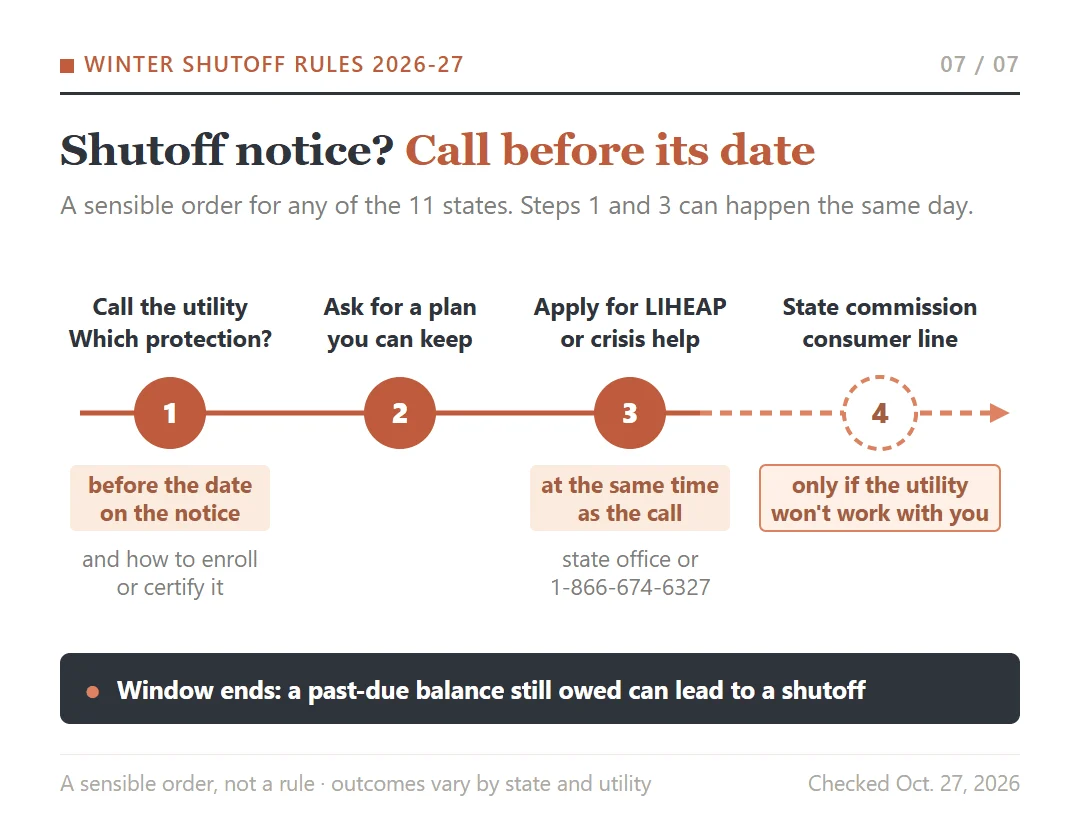
If a shutoff notice has arrived, or you’re already behind as the window opens, this is the order the state rules point to:
- Call the utility before the date on the notice and ask which winter protection applies to your account and how to enroll in it or certify it.
- Ask for a payment plan you can actually keep.
- Apply for LIHEAP, or its crisis component, at the same time, through your state office or the referral line.
- If the utility won’t work with you, contact your state commission’s consumer line.
I’m behind on my bill and want to stay connected this winter. Which winter protection applies to my account, and what do you need from me to enroll in it or certify it? Can we also set up a payment plan, and what’s the next date I need to know about on this account?
A medical certificate is a separate, year-round path in every state covered here: a doctor’s certificate can delay or stop a shutoff for a limited time, though the bill is still owed and a payment plan is usually needed. If someone in the home is seriously ill, ask the utility for its form.
Call the utility before the date on the notice, and call your state’s LIHEAP office or 1-866-674-6327 the same day.
Photos and icons in this post are illustrations made for explanation; they do not show real places, products or people.